







Spray vs roll vs brush: which method should a Toronto painter use?
There's no single best method. Spray, roll, and brush each win on specific surfaces, and a good Toronto painter uses all three on the same job. Spraying lays down a uniform film with no brush marks, where a brush leaves a film that changes thickness with every stroke and overlap. Match the tool to the surface and the result holds for years.
Key Takeaways
- Roll your walls, brush your edges, spray your trim, doors, and cabinets. No single tool wins every surface.
- Spraying gives a factory-smooth finish on doors, trim, and cabinets but adds 20-30% to labour for masking and setup, plus 20-40% more paint from overspray.
- Spray lays a uniform film; a brush varies in thickness across the same panel. That variation is what reads as brush marks under raking light.
- HVLP sprayers are for fine work (cabinets, doors); airless sprayers are for big surfaces (exteriors, empty interiors). Different guns, different jobs.
- Cutting in is brush work no sprayer can replace. Skip it and you get picture-framing within a year.
- Two coats minimum on every surface, every method. No tool delivers one-coat coverage over a real Toronto wall.
The "spray everything" crowd and the "real painters only brush" crowd are both wrong, and 20 years of house painting Toronto on walls, trim, and cabinets is what convinced me of it. The gun isn't magic and the brush isn't holy. They're tools. Each one does a job better than the other two, and the skill is knowing which goes where.
I get asked this constantly. "Can't you just spray the whole house and be done in a day?" Short answer, no, and you wouldn't want me to. A sprayed wall in your furnished living room means masking every surface in the room first, and the finish wouldn't even look better than a properly rolled one. Meanwhile your kitchen cabinet doors should absolutely be sprayed, because a brush will telegraph every stroke under your under-cabinet lights.
So let's go surface by surface. Walls, ceilings, trim, doors, cabinets, exteriors. When to spray, when to roll, when to brush, what it costs, and why. All pricing is CAD plus HST.
What does each method actually do to the paint film?
Each method deposits paint differently, and that's the whole story. A roller transfers paint efficiently with almost no waste and leaves a slightly textured film. A brush lays a variable film and cuts clean edges. A sprayer atomizes paint into a fine mist for a glass-smooth surface but loses a large share of the material to overspray. Three tools, three jobs.
The brush is your edge and detail tool. A loaded brush releases roughly 3-5 mils of wet film per pass and cuts a controlled line that no other tool can match. It's the only way to cut in along ceilings, corners, and trim. It also leaves visible stroke marks on flat panels, which is exactly why we don't brush cabinet doors.
The roller is your field tool. A 3/8-inch nap roller releases 6-9 mils per pass and covers open wall and ceiling area fast with very little wasted paint. The slight stipple it leaves is a feature on walls, not a bug. That texture scatters light and hides minor drywall flaws that a dead-flat sprayed film would reveal.
The sprayer is your smooth-finish and big-surface tool. It atomizes paint into a fine, even mist and lays a uniform 2-3 mil film with no marks at all. That's why it owns doors, trim, and cabinets. The cost is overspray and masking. Every surface you don't want painted has to be covered first.
From the job site: Spray deposits an even film with consistent sheen; a brush cannot hold that consistency across a panel. Field-applied paint is never perfectly uniform, which is why the trade standards set tolerances rather than a single number: PCA requires any spot to reach at least 80% of the specified dry film thickness, with the average of all measurements at 95% or better (PCA Industry Standards, 2023). That variation is what reads as brush marks under raking light on doors and cabinets.
The single most misunderstood point is that spray isn't automatically the best finish on every surface. On a cabinet door, spray wins by a mile. On a living-room wall, a rolled finish actually looks better than a raw sprayed one, because the roller's micro-texture hides flaws while the dead-flat spray film shows them. Smoother isn't always better. It depends on the surface.
Read more on the craft fundamentals in my painting tips guide.
HVLP vs airless: which sprayer does a Toronto pro use?
There are two sprayer families and they're not interchangeable. HVLP (high volume, low pressure) atomizes paint with a large volume of air at low pressure, giving fine control and minimal overspray for detail work. Airless pumps paint at very high pressure through a tip with no air, moving large volumes fast for big surfaces. HVLP is the cabinet and trim gun; airless is the exterior and empty-interior gun. Picking wrong wastes paint or wrecks the finish.
HVLP: cabinets, doors, fine trim
HVLP is what we run on anything that gets looked at up close. The low pressure and high air volume break the paint into a fine, controllable mist with very little bounce-back. You get a glass-smooth finish on cabinet doors, drawer fronts, and detailed trim. It's slow, it's fussy, and it's perfect for small detailed pieces you'll see from 18 inches under LED lighting.
The trade-off is throughput. HVLP can't move enough paint to spray a whole exterior in a reasonable day. It's a precision tool, not a production tool. We spray cabinet doors with HVLP in a controlled workshop where dust and overspray are managed, then reinstall.
Airless: exteriors, fences, empty interiors
Airless is the workhorse for big square footage. High pressure pushes large volumes of paint through the tip fast, so you can coat siding, fences, decks, and empty pre-flooring interiors quickly. The atomization is coarser than HVLP and the overspray is heavier, so it's wrong for fine cabinet work but right for a whole house exterior.
On exteriors, airless almost always gets paired with back-rolling. You spray the paint on, then immediately roll over the wet film to push it into the pores of the siding or stucco. Spray alone bridges over the texture instead of filling it. More on back-rolling below, because it's the step most DIY sprayers skip.
From the job site: HVLP sprayers atomize coatings with high air volume at low pressure for fine finish control and minimal overspray, making them my standard for cabinetry and fine trim. Airless sprayers deliver high-volume coverage at high pressure for large surfaces like exterior siding, at the cost of coarser atomization and heavier overspray.
Cabinet doors are the classic HVLP job. See the full cabinet painting cost breakdown.
Which method suits each surface in your home?
The right method is surface-specific, and a quality job mixes all three. Walls get rolled with brushed edges. Ceilings get rolled or sprayed depending on whether the room is empty. Trim, doors, and cabinets get sprayed for a smooth finish. Exteriors get sprayed and back-rolled. The decision matrix below is exactly how we spec a Toronto job, and it's drawn from 20 years of which approach actually holds up.
Walls: roll the field, brush the edges
Walls get rolled, full stop, in any occupied or furnished room. The roller lays a uniform, slightly textured film that hides minor drywall imperfections, and the brush cuts the edges clean. This is the standard for the overwhelming majority of Toronto interiors, and it's the right call. A sprayed wall in a furnished room means masking the entire room first, for a finish that doesn't even look better.
The one exception is a completely empty room before flooring goes in, where spraying walls and ceilings together can be faster. Even then, we back-roll the walls so the film matches a rolled finish and the texture stays consistent with the rest of the house.
Whatever you do, the edges get brushed. Cutting in is brush work that no sprayer can replace. And it has to be done twice, once per coat, into a wet roller edge. Cut in once and roll the field twice and you set up the picture-framing defect, a dark frame around every wall that shows up within a year. Two cut-ins, two roller passes, every wall.
Ceilings: roll, or spray an empty room
Ceilings usually get rolled with an 18-inch roller on a pole, which is fast and clean in an occupied home. If the room is empty and you're already spraying walls, spraying the ceiling first makes sense because there's nothing below to mask except the floor. A flat ceiling paint sprayed and back-rolled lays down beautifully.
The catch with spraying ceilings in a lived-in space is overhead overspray. Mist drifts everywhere and settles on anything you didn't cover. For a single ceiling in a furnished room, rolling is faster than the masking spray would require. I break ceiling technique down further here.
Trim, baseboard, and doors: spray for smooth, brush when occupied
Trim, baseboards, and doors are where spraying earns its keep on the interior. A sprayed satin or semi-gloss on trim lays glass-smooth with no brush marks, which matters because higher sheens reflect light and show every stroke. We spray these whenever the job allows the masking and the homeowner wants the smoothest result.
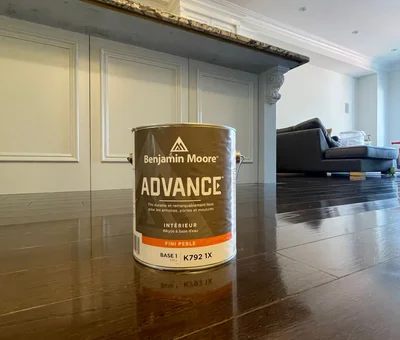
When a home is fully occupied and furnished, brushing trim is the practical call. A skilled hand with a quality angled brush and a self-leveling enamel like BM Advance gets very close to a sprayed look, and there's no room-wide masking. It's a real trade-off: spray for the absolute smoothest finish, brush to keep the project simple in a lived-in home. Full trim, baseboard, and door pricing is here. An exterior door is the one case where the coating decides the method, and we work through it in front door refinishing.
Cabinets: spray the doors, brush the boxes
Cabinet doors and drawer fronts get sprayed, no debate. You look at them daily from 18 inches under task lighting, and a brush telegraphs every stroke at that distance. We remove the doors, spray them with HVLP in a controlled workshop, and reinstall. The boxes mounted against the wall get brushed and rolled, because vertical box faces don't catch light the same way and the difference isn't visible in use. That hybrid spec is what most Toronto pro cabinet jobs deliver, and it's exactly how we run our cabinet painting work.
Exteriors: spray and back-roll
Exterior siding, soffits, and fences get sprayed with an airless rig, then back-rolled. That spray-and-back-roll routine is the standard on our exterior painting jobs. The spray moves paint fast across big square footage; the back-roll pushes it into the pores of the siding for a uniform film that won't flash or peel early. On rough cedar, stucco, and aged wood, skipping the back-roll leaves a thin film bridged over the texture that fails years early.
How much does each method actually cost in Toronto?
Method choice moves the price, but not the way most people assume. Spraying trim and cabinets adds roughly 20-30% to labour for masking, setup, ventilation, and cleanup, plus 20-40% more paint from overspray. On walls, spraying costs more for zero finish benefit, so rolling is both cheaper and better. The cost story flips by surface, and the chart below shows where each method wins on price versus finish.
Across our 2024-2025 Toronto jobs, the surfaces clients most often asked us to spray for finish quality were, in order: kitchen cabinet doors, interior doors, and trim. The surfaces clients assumed needed spraying but didn't were walls and ceilings in furnished rooms, where rolling delivered the same or better result for less money.
Where spraying is worth the premium
On cabinets, doors, and trim, the 20-30% labour premium and the extra paint buy a finish brushing can't match. A sprayed BM Advance door reads like factory cabinetry and wears evenly for 10-15 years. A brushed version of the same paint looks fine at handover, then telegraphs every stroke at year three to five as the film wears at high-touch zones. For surfaces you study up close, spray is money well spent.
Where spraying just costs more
On interior walls and most ceilings in furnished rooms, spraying adds masking labour and paint waste for a finish that's no better, and arguably slightly worse because raw spray shows drywall flaws the roller texture would hide. If a painter wants to spray your furnished living-room walls, ask why. The honest answer is usually that it's faster for them, not better for you. Rolling is the right, cheaper call.
From the job site: Spraying consumes noticeably more paint than rolling because of overspray and atomized drift, and it adds masking and setup labour that rolling avoids. On enclosed surfaces like cabinet doors the finish gain justifies the cost; on interior walls, rolling delivers equal or better results for less (Chad Caglak, HomePaintersPro Toronto, 2026).
DIY cost of entry: the gun is the expensive part
If you're doing this yourself, the math gets even more lopsided. An airless rig is a real purchase or a rental booking, plus tips, masking film, tape, and a respirator. A brush-and-roller kit, by contrast, is a handful of cheap tools you can buy on the way home and clean in a sink. For a one-room DIY job, the gun almost always loses on total cost.
It's not just the tool. Spraying that one room means masking everything you don't want painted and then cleaning a pump and hose afterward, which eats far more time than a rolled room. Rolling needs a tray, a roller, a brush, and a few minutes of cleanup. So for a single bedroom or living room, rolling wins on cost of entry, setup, and cleanup all at once. Roll the walls. The advice doesn't change when you're the one holding the tool.
See spray finishing as a standalone service.
What is back-rolling, and why does it matter?
Back-rolling is spraying paint on, then immediately rolling over the wet film before it sets. It's not optional on porous or textured surfaces. The roll pushes paint into the pores of new drywall, stucco, concrete, and rough siding, builds a uniform film, and leaves a consistent texture that matches rolled work elsewhere. Spray alone bridges over pores and pinholes instead of filling them, which causes flashing, thin spots, and early failure.
Here's the mechanic. When you spray a porous surface, the atomized paint lands and skins over the surface texture without working into the low spots and pinholes. It looks coated, but the film is thin and uneven where the surface dips. Roll over that wet film right away and you drive paint into every pore, equalize the thickness, and leave a uniform stipple. The result is a film that's both thicker where it needs to be and visually consistent.
Back-rolling matters most on three jobs: new drywall in an empty room, exterior siding and stucco, and bare concrete or masonry. On all three, spray-and-back-roll is faster than rolling alone but delivers the same reliable film. Skip the back-roll and you get the speed of spraying with the durability problems of a too-thin coat.
We took over a half-finished exterior in Etobicoke a few years back where another crew had sprayed the cedar siding without back-rolling to save a day. From the street it looked done. Up close, the spray had bridged over the wood grain and the paint sat on top instead of in the pores. Within two seasons it was flaking along every board edge. We sanded it back, sprayed and back-rolled it properly, and it's still holding. The back-roll is the step that makes a sprayed porous surface last. It's not where you cut a corner.
What you never back-roll is a smooth HVLP finish on doors or cabinets. Rolling over that wet film would destroy the glass-smooth surface that's the entire reason you sprayed it. Back-rolling is a big-porous-surface technique, not a fine-finish one. Right tool, right surface.
A real Toronto project: when we used all three methods
A Leaside semi we repainted last year is the clearest example of why no single method wins. The homeowners wanted the whole main floor and three bedrooms refreshed, the original trim and six interior doors brought back to smooth, and the kitchen cabinets done. One job, three tools, each on the surface where it belongs.
Walls and ceilings, occupied and furnished, got brushed edges and rolled fields. Two cut-ins, two roller passes, every wall, into a wet edge so there'd be no picture-framing at year one. We boxed the wall paint so the colour stayed uniform can to can. Nothing fancy, just the disciplined standard that holds up.
The six interior doors and the trim came off or got masked, and we sprayed them with HVLP in BM Advance satin. Glass-smooth, no brush marks, exactly what the homeowner wanted on the surfaces she'd see up close every day. The cabinet doors went back to the workshop for HVLP spraying, boxes brushed in place. The whole main floor and three bedrooms, walls rolled, came in around $6,800 CAD plus HST. The trim, doors, and cabinet spray work added on top of that, quoted separately and disclosed up front.
The point isn't the number. It's that a quality Toronto repaint isn't a spray job or a brush job. It's a roll-the-walls, brush-the-edges, spray-the-fine-work job. Anyone selling you "we'll just spray the whole thing" is selling you their speed, not your finish.
So which method should you choose?
Match the tool to the surface and you can't go wrong. Roll your walls with brushed edges. Roll ceilings, or spray them only in an empty room. Spray trim, doors, and cabinet doors for the smoothest finish, or brush trim when the home is occupied and masking isn't practical. Spray and back-roll exteriors. Two coats on every surface, every method, no exceptions.
And here's the part that matters more than any of it: the tool doesn't make the painter. I've seen glass-smooth sprayed cabinets fail in a year because the prep was rushed, and I've seen hand-brushed trim outlast them because the surface was degreased, sanded, and primed right. Spray, roll, and brush are just ways to move paint. What decides whether your job looks good at year five is the prep underneath and the discipline to do two real coats and cut in twice. Prep and craft beat the tool, every single time.
If you want an honest walk-through of which surfaces in your home should be sprayed, rolled, or brushed, and a fixed CAD price with HST disclosed before any work starts, that's exactly what we do. Request a free quote or call me at (416) 875-8706. We'll spec the right method for every surface and put it in writing.
About the author
Chad Caglak is co-owner of Home Painters Pro Toronto and a 20-year working painter. He's sprayed cabinets and exteriors, rolled countless interiors, and hand-brushed trim in occupied homes from Leaside semis to CityPlace condos, and writes the craft-and-pricing content here so Toronto homeowners can match the right tool to each surface instead of paying to spray where a roller wins. Read more in trim and door painting costs or kitchen cabinet painting costs.
Frequently Asked Questions
Roll your walls. For nearly every occupied Toronto home, brush-and-roller is the right call on interior walls. Spraying a wall means masking every window, floor, ceiling line, outlet, and fixture, which adds hours and only matters when the room is empty and you're spraying ceilings and walls together before flooring goes in. A back-rolled wall and a sprayed-then-back-rolled wall look nearly identical at conversational distance, and the roller leaves a slightly textured film that hides drywall imperfections better than raw spray. Save spraying for trim, doors, cabinets, and large empty surfaces. Roll the walls.
HVLP (high volume, low pressure) sprayers atomize paint with a high volume of air at low pressure, giving fine control and minimal overspray. They're the cabinet and fine-trim tool: glass-smooth finish, slow, best on small detailed pieces. Airless sprayers pump paint at very high pressure through a tip with no air, moving large volumes fast. They're the exterior and big-surface tool: fast coverage on siding, fences, and empty interiors, but heavier overspray and a coarser atomization than HVLP. Pros run HVLP for doors and cabinets, airless for exteriors and pre-flooring interiors. Different jobs, different guns.
Yes. Spraying typically uses 20-40% more paint than rolling because of overspray and the fine mist that drifts past the surface or bounces off. Airless spraying on exteriors wastes the most; HVLP on enclosed cabinet doors wastes the least. Rolling transfers paint efficiently with very little waste. So spraying costs you more in material even before the extra masking labour. The trade is finish quality: on doors, trim, and cabinets, the factory-smooth sprayed result is worth the extra paint. On walls, where rolling looks great, the extra paint and masking buys you nothing.
It depends on the surface. On cabinets, doors, and trim, spraying adds roughly 20-30% to labour for masking, setup, ventilation, and cleanup, plus 20-40% more paint, but the factory-smooth finish justifies it. On walls, spraying actually costs more for no finish benefit, so rolling is cheaper and just as good. On large empty interiors before flooring, or full exteriors, spraying plus back-rolling can be faster and cost-competitive because there's nothing to mask. Always ask your painter which method they're using on which surface, and why. All pricing in this guide is CAD plus HST.