




Why is my paint failing? Start with the symptom, not the paint
Almost every Toronto paint problem belongs to one of five families: adhesion failure (peeling), trapped heat or moisture (blistering), stain bleed-through, building movement (cracking), or an application defect. You name the family by looking at the shape, the location, and what the surface does, and that names the cause. In my experience the large majority of premature failures come from prep, moisture, and the wrong primer, not the paint in the can (Benjamin Moore).
Key Takeaways
- Five families cover nearly every Toronto paint problem: adhesion (peeling), heat/moisture (blistering), stain bleed-through, movement (cracking), and application defects
- Diagnose by shape and location first; the symptom names the cause, and the cause decides the fix
- Repainting without fixing the cause just reproduces the defect on schedule, often within one season
- Stains and water marks need a shellac stain blocker (Zinsser BIN), not latex, which will always let them bleed back
- Peeling over old oil or gloss needs a bonding primer; latex has nothing to grip without it
- Recurring cracks are usually seasonal house movement, not a failed patch
- Bathroom mould is a humidity and ventilation problem first, a paint problem second
- Every fix is the same shape: find the cause, fix it, scrape to a sound edge, prime correctly, two full coats
I'm Chad Caglak, co-owner of HomePaintersPro Toronto and a 20-year working painter, and "something's wrong with my paint" is one of the most common calls I get. The problem is that a dozen different defects get described with the same three words: peeling, bubbling, staining. They are not the same problem and they do not share a fix.
So treat this page as a map. Find your symptom below, read across to the cause, then follow the link to the full guide for that defect. Get the family right and you are most of the way to a repair that actually holds. Chase the symptom and you will be back on a ladder next spring.
The Toronto paint problem decision matrix
Most failures sort into five families, and you can place yours in about ten seconds from the shape, the location, and what happens when you touch it. This is the matrix I run in my head on every callback: match the symptom, read across to the cause, then go to the right guide.
When you diagnose a Toronto paint problem, the shape and location name the family: sheets lifting away is adhesion failure, a raised dome is a heat or moisture blister, a returning brown mark is stain bleed-through, a seasonal crack is movement, and fuzzy spots are mould. Each family has its own cause and its own guide below, so the matrix is your starting point, not the whole answer.
Family 1: Peeling, flaking and adhesion failure
Peeling is the paint film letting go of the surface or the coat below it, in sheets and strips that dry brittle and flake into chips. The cause is almost always that the paint had nothing to grip: a glossy, dirty, chalky, or wet surface, or the Toronto special, modern latex applied straight over old oil-based trim with no bonding primer. The film looked fine for a few weeks, then sheared off the first time something touched it.
Old oil paint is the one that catches Toronto homeowners out, because so many houses here have oil-painted trim, doors, and railings from earlier decades. Latex does not chemically bond to cured oil, so without a bonding primer it peels like a sticker. The tell is a clean, glossy back on the peeled film and a slick surface underneath with no torn substrate.
The fix is never to paint over what is loose. Scrape back to a sound edge, feather the transition smooth, de-gloss and spot-prime with the right bonding primer, then two full coats. No premium paint covers a repaired or recoated area in one pass, you always plan for two.
For the full breakdown of peeling versus blistering versus alligatoring and how to tell them apart, see paint blistering vs bubbling vs peeling. For the trim-and-door version specifically, the oil-paint problem, read latex over oil paint peeling.
Family 2: Blistering and bubbling from heat or moisture
A blister is the paint film lifting off the surface into a raised pocket, and the two culprits are heat and moisture. A heat blister forms when you paint a hot or sun-baked surface and the top skins over before the layer below can release its vapour; it shows up fast, on the sunny side, and bottoms out on still-attached primer. Painting in direct sunlight and high heat is among the leading causes of blistering (Benjamin Moore).
A moisture blister is the slower, meaner version. Water gets behind the film from a leak, from steam in a poorly vented bathroom, or from damp masonry, and lifts it from the back. These appear weeks or months later, feel soft or damp, and come back every time the moisture returns until you find and stop the water. Pop one and look underneath: a moisture blister goes all the way to bare, often damp, substrate.
The fix follows the cause. Heat blister: repaint in shade on a mild day. Moisture blister: stop the water, let the wall dry fully, then prime and apply two coats. The full diagnostic, including the under-the-blister test and the heat-versus-moisture table, lives in paint blistering vs bubbling vs peeling.
Family 3: Stains bleeding through fresh paint
This is the one that makes people think their paint is defective. You roll two coats over a brown ceiling ring or a yellow wall and the mark ghosts straight back through. The paint is fine. The problem is that water stains, nicotine and smoke tar, and wood tannins are soluble, and a water-based latex topcoat re-wets them and carries the discolouration up into the new film. Latex will never seal these stains, no matter how many coats you add.
The fix is a stain-blocking primer, and for the stubborn ones that means shellac. A shellac-based primer like Zinsser BIN locks the stain down so it cannot migrate, then you topcoat over the primer. This is also where the "paint and primer in one" myth falls apart: a self-priming paint spot-covers minor touch-ups, but it does not seal a real stain. Stains need a dedicated stain blocker, full stop.
The two most common Toronto stain-bleed jobs are ceiling water rings and the tar film smokers leave behind. Each has its own full guide:
- For brown ceiling rings that keep returning, see water stain bleeding through ceiling paint.
- For a stained popcorn ceiling, where you also have to judge repair versus replace and watch for pre-1990 asbestos, see popcorn ceiling water stains, sagging or flaking.
- For the yellow tar film from cigarettes that reactivates through latex, see painting over nicotine and smoke stains.
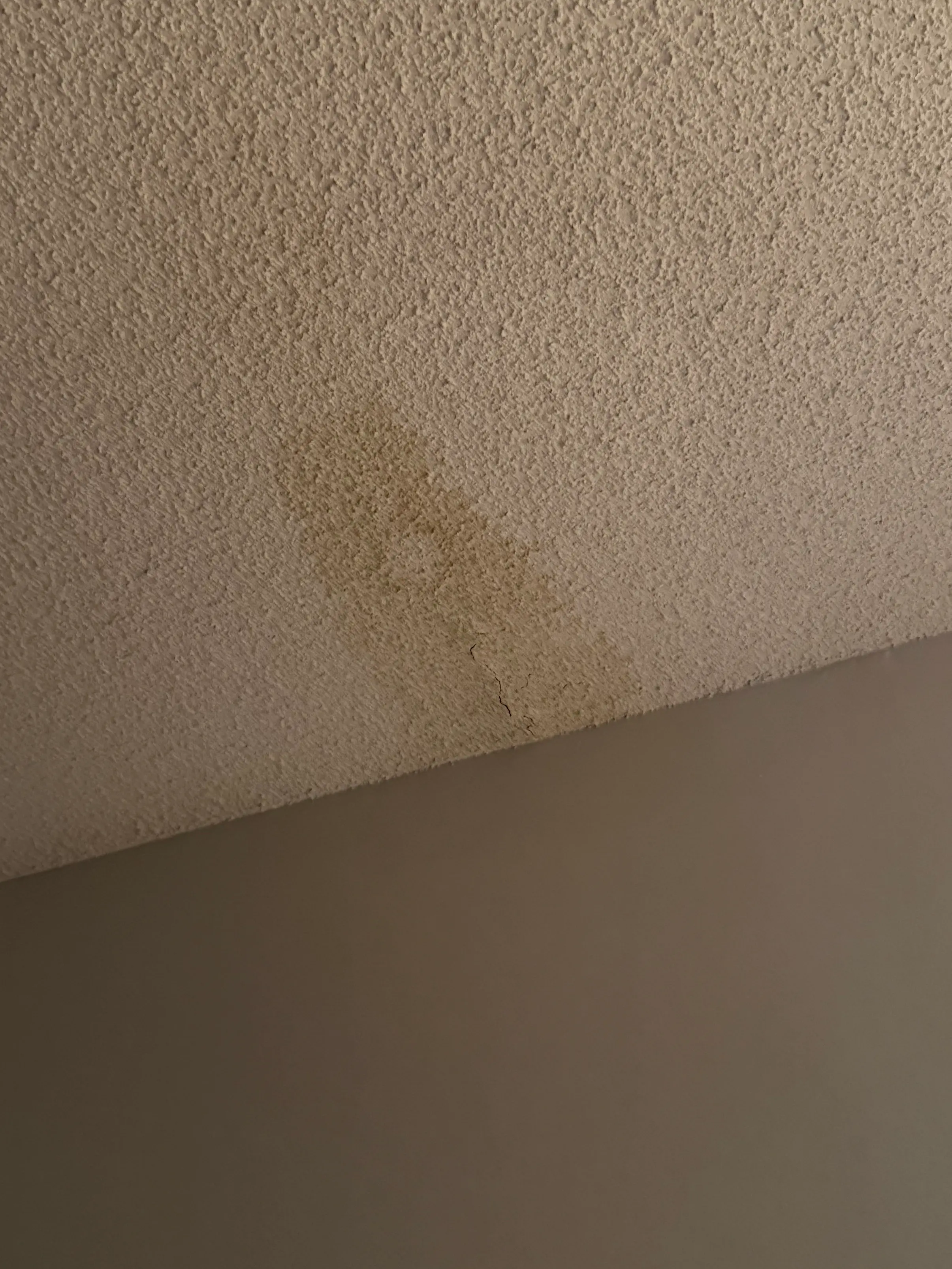
[UNIQUE INSIGHT] Why "I already used three coats" never works on a stain: Homeowners assume a stain that bleeds through two coats just needs a third. It does not, because the topcoat is the thing carrying the stain up. Each new latex coat re-wets the soluble mark and lifts it again, so you can roll five coats and still see the ring. The only thing that stops it is a barrier the stain cannot dissolve into, which is what a shellac primer is. One coat of the right primer beats ten coats of the wrong topcoat.
Family 4: Cracks that keep coming back
A hairline crack that returns in the same spot every winter is almost never a failed patch. It is the house moving. Toronto's swing from humid summers to bone-dry, heated winters makes framing and drywall expand and contract, and the movement concentrates at predictable weak points: the corners of doors and windows, the joints where walls meet ceilings, and along ceiling seams in homes with roof trusses. You patched it, the patch was fine, and the seasonal movement opened it right back up.
That is why smearing filler and paint across a recurring crack fails. Rigid filler in a joint that flexes just cracks again at the next season change. The durable fix addresses the movement: a flexible repair at the joint, sometimes paintable caulk where two surfaces meet, sometimes a proper taped-and-bedded repair where the drywall itself is moving, so the joint can flex without telegraphing a crack through the paint.
The full explanation, including seasonal cracking, truss uplift at ceiling-wall joints, and when a crack is normal versus when it signals something structural, is in why do hairline cracks keep coming back. For broader drywall damage and patching, our drywall repair guide for Toronto tenants and owners covers the prep side.
Family 5: Bathroom ceiling mould and peeling
Bathrooms generate their own cluster of paint problems because of one thing: humidity. Steam with nowhere to go condenses on the coolest surface in the room, the ceiling, and feeds two failures. The first is peeling, where moisture works behind a film that was never sealed or was painted with the wrong product. The second is mould, the fuzzy black or green spotting that keeps coming back no matter how often you wipe or repaint.
Both are ventilation problems before they are paint problems. An exhaust fan that is undersized, vented into the attic instead of outside, or simply not run long enough leaves moisture in the room every shower. Keeping indoor relative humidity controlled, especially in Toronto's dry heated winters, and venting the fan properly to the exterior is what actually stops the cycle. Paint over live mould or an unfixed humidity source and it returns within weeks.
Once ventilation is handled, the paint choice matters. For bathroom ceilings and showers my default is Benjamin Moore Aura Bath & Spa: it is built for high-humidity rooms, with strong mildew resistance and a matte finish that hides ceiling imperfections, which is exactly what a steamy ceiling needs (Benjamin Moore).
Each bathroom failure has its own guide:
- For a ceiling that peels after showers, see why is paint peeling off my bathroom ceiling.
- For mould that keeps coming back through the paint, see why your bathroom ceiling keeps growing mould.
Family 6: Application defects, when the paint is sticking but the wall looks wrong
Not every paint problem is a failure of adhesion or moisture. Some are application defects: the paint is bonded fine, but the wall looks patchy, streaky, or uneven. The usual suspects are flashing (uneven sheen or colour where a patch or porous spot absorbed paint differently), roller marks and stipple, and picture-framing, what we call boxing, a darker frame around the edges of a wall or ceiling.
Boxing is the most common and the most avoidable. It happens when a painter cuts in the perimeter with a brush but only rolls the field once, so the edges get two coats and the centre gets one. Two coats over one reads darker, and you end up with a permanent frame visible from across the room. The fix is simple discipline: cut in twice and roll twice, so every square inch gets the same two full coats. Flashing usually traces to skipping primer over patches and bare repairs, which then dry to a different sheen than the sealed wall around them.
If a previous job left you with patchy coverage, roller marks, or flashing, the full reset, diagnose, sand, prime, and get two even coats, is in how to fix a bad paint job. The craft thinking behind why two cut-ins and two roller coats matter is covered in our Toronto painter craft hub.
[ORIGINAL DATA] What our callback log shows: Across the repaint callbacks we logged from 2023 through early 2026, the single biggest "the paint is fine but it looks wrong" complaint was boxing, and nearly every case traced to the same root: cut in once, rolled the field once. The cut-twice, roll-twice rule would have prevented all of them. It is the cheapest defect to avoid and one of the most common we get called to fix.
The universal fix: every paint problem follows the same five steps
Whatever family your defect belongs to, the repair has the same shape, and the first step is the one people skip. In my experience the vast majority of premature paint failures come from the cause being ignored, not from bad paint. Repaint without fixing the cause and you have paid to reproduce the same defect on a timer.
- Diagnose and fix the cause. Moisture or stain? Find and stop the water, then dry the surface fully. Mould? Kill it and fix the ventilation. Peeling over gloss or oil? Plan to de-gloss and bonding-prime. Movement crack? Decide on a flexible repair. No paint goes on until the cause is handled.
- Scrape and clean back to a sound surface. Remove everything loose, lifted, or cracked; whatever stays down tight after firm scraping is sound and can stay. Clean off grease, chalk, and dust so the new coat has something clean to grip.
- Sand and feather. Sand transitions so the edge of the old paint blends smooth into the bare area. A hard scrape ridge will telegraph through the new coats, so feather it flat.
- Prime correctly for the cause. Bare drywall or wood gets a real primer like Fresh Start. Water, nicotine, and tannin stains get a shellac blocker like Zinsser BIN. Old oil or glossy surfaces get a bonding primer. Paint-and-primer-in-one is not a substitute here; it only spot-covers minor patches.
- Two full coats, right conditions. Two coats over the prepped, primed surface, on a dry surface, out of direct sun, on a mild day. No premium paint properly covers a repaired or recoated area in a single coat.
For the complete surface routine that prevents most of these problems in the first place, see our wall prep checklist. And if you are not sure whether your existing trim is oil or latex, which changes the whole prep, our guide on how to tell if paint is oil or latex shows the two-minute test.
Every Toronto paint problem guide, in one place
Use this as the directory. Find your symptom, open the full guide:
- Paint blistering vs bubbling vs peeling — the master defect dictionary for raised pockets, peeling, and alligatoring.
- Latex over oil paint peeling — peeling trim and doors over old oil paint.
- Water stain bleeding through ceiling paint — brown rings that ghost back after repainting.
- Popcorn ceiling water stains, sagging or flaking — stained textured ceilings, repair-versus-replace, and the asbestos warning.
- Why is paint peeling off my bathroom ceiling — steam-driven peeling and the right bathroom paint.
- Why your bathroom ceiling keeps growing mould — humidity, ventilation, and killing mould properly.
- Why do hairline cracks keep coming back — seasonal movement, truss uplift, and the flexible fix.
- Painting over nicotine and smoke stains — yellow tar film that reactivates through latex.
- How to fix a bad paint job — patchy coverage, roller marks, flashing, and boxing.
Get a Toronto paint problem diagnosed and fixed
Twenty years diagnosing why Toronto paint fails: peeling off old oil trim, blisters fed by leaks and steam, water stains ghosting through ceilings, mould on bathroom ceilings, and cracks that open every winter. Every repair we do starts the same way, finding the cause and fixing that first, then scraping to a sound edge, priming for the actual problem, and laying down two full coats that hold.
Get your free repair quote or call (416) 875-8706. Quotes inside 24 hours, fixed CAD pricing, HST disclosed.
We handle defect repairs on their own or as part of a full interior painting project, with drywall repair and water-damage repair when the surface behind the paint needs work too.
About the author
Chad Caglak is co-owner of HomePaintersPro Toronto and a 20-year working painter. He has diagnosed and fixed paint failures on everything from CityPlace condos to century homes in Leaside, and writes the craft-and-pricing content here so Toronto homeowners can name a defect before they spend a dollar. Read more from Chad in the Toronto painter craft hub or the wall prep checklist.
Frequently Asked Questions
Start with the shape and the location, not the paint brand. A raised pocket is blistering or bubbling from trapped heat or moisture. A film lifting away in sheets is peeling, an adhesion failure. A brown or yellow mark coming back through fresh paint is a stain bleeding through, which latex cannot seal. A crack that returns every winter is house movement, not a bad patch. Fuzzy black or green spots are mould tied to humidity. Match your symptom to one of those five families and you have found the cause, which is the whole job. Repainting without naming the cause just reproduces the same defect.
Because repainting treats the symptom, not the cause. A moisture blister comes back until you stop the water. A water stain ghosts back because latex paint will never seal it, only a shellac-based primer like Zinsser BIN will. Mould returns because the spores are still alive under the new coat and the humidity that fed them has not changed. Peeling over old oil keeps peeling until a bonding primer goes down. Every recurring defect is telling you the underlying cause was never fixed. Find and fix that first, then the paint holds.
Not directly, no, and that is the most common mistake I see in Toronto homes. Stains need a shellac stain blocker before paint or they bleed back. Peeling has to be scraped to a sound edge and spot-primed or the new coat peels with the old. Cracks need the right filler and sometimes a flexible repair, not just paint smeared across them. And no premium paint covers a repair or a colour change in one coat, you need two full coats over correct prep. Paint is the last step, never the fix on its own.
Sometimes, and it is worth knowing before you paint over it. A moisture blister or a water stain on a ceiling can point to a roof, plumbing, or flashing leak that needs fixing first. Recurring bathroom mould usually means the exhaust fan is undersized, vented into the attic, or not run long enough. Cracks that open every winter are normal seasonal movement, but a crack that keeps widening can mean a structural issue. The paint defect is often the visible symptom of a building problem, so diagnosing it correctly can save you from sealing a leak inside your wall.
Rarely, because most paint problems are prep and condition problems, not paint-quality problems. In my experience the large majority of premature failures trace back to surface preparation, moisture, and the wrong primer, not the paint in the can. A top-tier paint over a glossy unsanded surface still peels. A premium ceiling paint over an unsealed water stain still lets the stain bleed through. Good paint matters for durability and washability once the surface is right, but it cannot rescue bad prep. Prep and the correct primer decide whether the job lasts, not the price of the topcoat.
A single problem area, one stained ceiling, a peeling wall, a cracked corner, typically runs about $300 to $700 CAD plus HST in Toronto, depending on how much scraping, sanding, priming, and patching it needs. Whole rooms with widespread failure cost more because the prep is the real work, not the painting. The wildcard is always the cause: a leak, a failed fan, or a moisture source has to be fixed first, and that can be separate trade work. We diagnose the cause at the quote so you are pricing the actual repair, not just a coat of paint over the problem.
Anything with a moisture or mould source behind it, anything on a pre-1990 popcorn ceiling, and any widespread failure across a whole room are the ones to be careful with. Pre-1990 textured ceilings can contain asbestos and should be tested before you scrape. Recurring mould and moisture need the source diagnosed, not just sealed over, or you trap a damp problem inside the wall. A small stain you can shellac and a single peeling patch you can scrape and prime are reasonable DIY repairs. When the cause is unclear or the area is large, a diagnosis visit saves you from repainting the same defect twice.
A repair done right, cause fixed, surface scraped and feathered, correct primer, two full coats, should last as long as a fresh paint job: roughly ten to fifteen years on interior walls in normal conditions, less on high-traffic or high-moisture surfaces like bathroom ceilings and trim. The thing that shortens it is almost always an unfixed cause. If the leak, the humidity, or the adhesion problem is handled, the repaired area outlasts the rest of the wall. If it is not, you will see the same defect again within a season or two, which is the clearest sign the cause was skipped.