




Why is paint peeling off my bathroom ceiling?
Paint peels off a bathroom ceiling because steam keeps soaking a film that was never built or primed for moisture. Hot shower air rises, sits on the ceiling, and works behind the paint until it lets go. Persistent indoor moisture is the documented root cause of this kind of surface failure (Health Canada, 2024). The paint is the symptom. The wet ceiling is the disease.
Key Takeaways
- Bathroom ceilings peel because trapped steam lifts a film that was wrong for moisture or went on over bad prep
- Fix the moisture source first: a fan that vents outside and actually gets used, per Health Canada guidance (2023)
- Peeling in sheets is an adhesion failure, flaking in spots is moisture pushing from behind, the diagnosis changes the fix
- You cannot paint over peeling paint, scrape to a sound edge, dry the ceiling 48 to 72 hours, then prime stains
- Two coats of a moisture-built paint like Benjamin Moore Aura Bath & Spa in matte, never one coat, never over live mildew
- Toronto winters drive condensation as warm steam hits a cold ceiling, which is why peeling often starts in February
- Typical fix runs $250 to $500 CAD plus HST, more with drywall repair, far less than doing it twice
I'm Chad Caglak, 20 years of interior painting Toronto work, and the peeling bathroom ceiling is one of my most common call-backs. Not call-backs on my own work. Call-backs to undo someone else's. The story is almost always the same. The ceiling looked great for a year, then a corner started lifting, then a sheet came down in the shower.
Here's the thing nobody wants to hear. The paint failing is not the problem. It's the receipt for a problem that's been there all along. Steam with nowhere to go. A fan venting into the attic. A flat ceiling paint with zero moisture rating. Fix those, and the ceiling stays put. Skip them, and you'll repaint every winter.
For the full room treatment, start with our bathroom painting guide.
What are the four real culprits behind a peeling ceiling?
Four causes drive almost every peeling bathroom ceiling: trapped steam, the wrong paint, a fan that doesn't vent outside, and a coat applied over an old failing surface. Health Canada lists bathroom exhaust fans that are not working properly, not vented outside, or simply not used among the standard causes of an indoor moisture problem (Health Canada, Guide to Addressing Moisture and Mould Indoors, 2023). Usually it's two or three of these stacked together, not just one. That's why a single fix rarely holds.
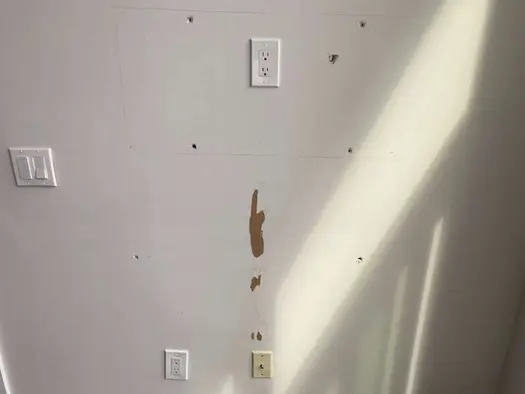
A peeling bathroom ceiling is rarely a paint defect on its own. It is the visible result of trapped steam, a coating with no moisture rating, an exhaust fan that does not vent outdoors, and paint applied over an unsound old surface. Health Canada identifies persistent moisture as the controlling factor in interior coating failure and mould growth, so the durable fix starts with ventilation, not with a better brush. In 20 years, almost every peeling ceiling I'm called to fix traces back to the air in the room, not the can on the shelf.
The four break down like this, because the fix depends on which ones you've got.
| Culprit | What you'll see | The fix |
|---|---|---|
| Trapped steam and condensation | Flaking and bubbles where warm shower air condenses on and behind the film, ceiling never dries between showers | Vent the steam out so the ceiling can dry; ventilation before any repaint |
| The wrong paint went on | Soft, papery sheets that come off easily; standard flat ceiling paint with no moisture or mildew rating | Strip the failed coat, recoat with a moisture-built paint (Aura Bath & Spa, matte, two coats) |
| No working exhaust fan | Fan that vents into the attic or cavity, or never gets switched on, leaving the ceiling saturated after every shower | Confirm the fan exhausts outdoors and actually gets used during and after showers |
| Painted over old, failing paint | Fresh coat peeling together with a loose, glossy, or contaminated old coat that was never scraped or primed | Scrape to a sound edge and prime first; remove the failed film before recoating |
Trapped steam and condensation
Steam is the big one. A hot shower can push bathroom humidity past 90 percent in minutes, and that warm wet air rises straight to the ceiling. If it can't escape, it condenses on and behind the paint. Day after day, that moisture works between the film and the drywall until adhesion gives. The ceiling peels because it never gets a chance to dry.
The wrong paint went on
Standard flat ceiling paint has almost no moisture or mildew resistance. It's built to hide drywall flaws in a dry bedroom, not to survive a steam bath. Put it on a bathroom ceiling and it absorbs moisture, softens, and lets go. [PERSONAL EXPERIENCE] On scrape-offs, I can usually tell within thirty seconds whether someone used a real bathroom paint or grabbed leftover ceiling white. The cheap stuff comes off in soft, papery sheets.
No working exhaust fan
This is the cause homeowners miss most. A surprising number of Toronto bathroom fans vent into the attic or ceiling cavity instead of outside, which just relocates the moisture above your head. Others work fine but never get switched on. Either way, the steam stays in the room and lands on the ceiling. Paint can resist humidity. It can't out-run a room that never dries.
Painted over old, failing paint
The last culprit is a shortcut. Someone rolled fresh paint over a ceiling that was already lifting, glossy, or contaminated, without scraping or priming. The new coat bonds to the loose old coat, and they peel together. Benjamin Moore is blunt about this in its peeling guidance: remove the failed film first (Benjamin Moore, 2026).
If steam has already soaked into the drywall, see our water and moisture damage repair service.
Is my ceiling peeling in sheets or flaking? Why it matters
The pattern tells you the cause. Paint coming off in big sheets is an adhesion failure: a coat that never bonded to what's under it. Small flakes and bubbles spread across the ceiling point to moisture pushing through the film from behind. Health Canada frames both as moisture-driven, but the path differs (Health Canada, 2024). Read the pattern before you reach for a scraper.
Sheets usually mean prep was skipped. Somebody rolled latex over an old oil-based ceiling, or over a glossy coat, or over dust and soap film, with no sanding and no bonding primer. The new film never had a grip to lose. You'll often peel a sheet off and find the old paint underneath still stuck tight. That's your tell.
Flaking and little bubbles tell a different story. That's moisture working from the back, lifting the film in small pockets where steam found a way in. [UNIQUE INSIGHT] Here's the part most homeowners get backwards: flaking is the better problem to have a paint product solve, because a moisture-built coat and a working fan address it directly. Sheet peeling is a prep problem, and no paint on the shelf fixes bad prep.
For the wider failure vocabulary, read paint blistering vs bubbling vs peeling.
Do I need to fix the exhaust fan before repainting?
Yes, and it's the step that decides whether the repaint lasts. A bathroom fan has to vent outdoors, run during every shower, and keep running well after you towel off. Health Canada's checklist is explicit: an exhaust fan in every bathroom, vented outside and not into the attic, used every time you shower, and left running at least 30 minutes after (Health Canada, Guide to Addressing Moisture and Mould Indoors, 2023). Repainting over an unventilated ceiling just resets a clock that's going to run out again. Air first. Always.
I tell people to run a simple test. Hold a square of toilet paper up to the running fan. If it doesn't hold against the grille, the fan isn't moving real air, and the steam from your shower is staying in the room. The second test is colder comfort: go into the attic and check where the duct goes. If it just dumps into the cavity, that moisture has been collecting above your ceiling for years.
A bathroom exhaust fan must vent outdoors, run during each shower, and keep running at least 30 minutes after, or steam saturates the ceiling and lifts the paint film regardless of product quality. Health Canada lists bathroom fans that are not working properly, not vented outside, or not used among the standard causes of an indoor moisture problem, so confirming the fan works and exhausts outside is the first repair step, ahead of any scraping or painting. I check the fan before I open a single can on these jobs.
Why repaint a ceiling that's going to soak again by February? It's like drying a towel in the rain. Fix the air movement, and the new paint has a fair chance. That's the whole game.
How do I fix a peeling bathroom ceiling for good?
The durable fix is a sequence, not a single coat. Solve the moisture source, scrape the failed paint, dry the ceiling fully, prime the stains, then roll two coats of a moisture-built paint. Benjamin Moore's own troubleshooting requires removing failed film before recoating (Benjamin Moore, 2026). Skip any step and the ceiling tells on you within a year.
This is the exact order I run on a peeling Toronto bathroom ceiling.
- Fix the moisture source first. Confirm the fan vents outside and gets used, and rule out any roof or upstairs plumbing leak. No point painting until the ceiling can dry.
- Scrape back to sound paint. Take every loose flake off with a putty knife until you hit paint that won't lift. Feather-sand the hard edges so the transition doesn't telegraph through the topcoat.
- Dry the ceiling fully. Give it 48 to 72 hours of ventilated, heated time, longer if the drywall got soaked. Damp drywall under fresh paint just peels again.
- Kill and block mildew. If there's any mildew, clean and kill it first, never paint over live growth. Use a diluted household bleach solution or a dedicated mildewcide cleaner on the affected spots, then rinse and let the ceiling dry fully before any primer touches it. Painting over live growth just feeds it back through the new film. Then spot-prime the stains and previously affected areas.
- Prime with a stain blocker. Zinsser BIN shellac locks water stains and mildew ghosting so they don't bleed through. Bare drywall patches get Benjamin Moore Fresh Start. Paint-and-primer-in-one only spot-covers minor patches, it does not seal stains or raw drywall.
- Two coats of moisture-built paint. Benjamin Moore Aura Bath & Spa in matte, rolled edge to edge in two full coats. No moisture paint covers a repaired bathroom ceiling in one.
For the surface-prep fundamentals behind step two, see our complete wall prep checklist. For ceiling-rolling technique on step six, see how to paint a ceiling properly. A peeling ceiling is one of five paint-defect families, all mapped in our Toronto paint problems hub.
Will Aura Bath & Spa stop my ceiling from peeling?
It will, as long as the moisture source is solved first. Benjamin Moore Aura Bath & Spa is engineered for high-humidity rooms, with mildew resistance built into the film and a matte finish that hides ceiling flaws. It out-survives standard flat ceiling paint in a steam bath by a wide margin. But the paint is the last line, not the first. No coating beats a ceiling that never dries.
[ORIGINAL DATA] On the recurring-peel bathrooms we've fixed, the pattern is consistent: the ones that came back within two years almost all had a fan that didn't vent outside, and the ones we fixed for good had the fan sorted first. The paint was the same in both cases. The ventilation is what separated the lasting fixes from the redos. That's not a knock on the paint. It's the whole point about sequence.
Why does the matte matter on a ceiling? Because bathroom ceilings get hit by hard, raking light from the vanity, and any sheen lights up every patch and roller mark. Matte settles the surface down and reads clean. You get the mildew resistance and the forgiving finish in one product, which is exactly why it's our default for the surface that takes the worst of the steam.
A quick honesty note on whites. Most bathroom ceilings are painted white, and Bath & Spa earns its spot here purely on moisture and mildew performance, not colour-locking, because there's no saturated pigment to lock in a soft white. You're buying the moisture build. That's the right reason to spend it on this ceiling.
For a deeper diagnosis of what's growing up there, see bathroom ceiling mould in Toronto.
Why does my Toronto bathroom ceiling peel worse in winter?
Toronto winters make peeling worse because cold attic surfaces above a steamy bathroom drive heavy condensation onto the ceiling. Hot shower air hits a cold ceiling plane and water forms on and behind the film. Health Canada names moisture condensing on cold surfaces as one of the standard sources of an indoor moisture problem (Health Canada, Guide to Addressing Moisture and Mould Indoors, 2023). That February soaking is why a ceiling that looked fine in July starts lifting by late winter.
The mechanism is simple physics. Warm, wet air can hold a lot of moisture. The second it touches a cold surface, it can't hold that water anymore, and the water drops out onto whatever's there. In a Toronto bathroom in January, that cold surface is your ceiling, chilled from below by the attic. Every shower deposits a fresh layer of condensation right where the paint is trying to hold on.
This is why I push so hard on the fan and the duct. An uninsulated metal duct running through a cold attic actually makes condensation worse, because the warm exhaust hits cold metal and drips back down toward the fan housing. Get the duct insulated and vented out a roof or wall cap, run the fan long enough to clear the steam, and you break the winter cycle that peels the film.
If you're seeing a defined brown stain rather than general peeling, that's likely a leak, not just steam. Read water stains bleeding through ceiling paint in Toronto before you paint over it.
How much does it cost to fix a peeling bathroom ceiling in Toronto?
A scrape, prime, and two-coat repaint of a standard bathroom ceiling runs roughly $250 to $500 CAD plus HST. Add drywall repair for soft or water-damaged areas and it climbs toward $600 to $900. Bathroom ceilings cost more per square foot than bedroom ceilings because of the slow cut-in work around the fan, the light, and the tile line, plus the premium moisture paint.
The wildcard is what's hiding under the peel. If the scrape reveals soft drywall, lifted tape, or active mould, that's repair work before any paint goes on, and it moves the number. A clean ceiling that just needs scraping, spot-priming, and two coats sits at the low end. A ceiling with a past leak and damaged board sits at the high end. We price both honestly on the quote, not at the invoice.
One point is worth repeating. The cheapest option, rolling fresh paint over the peel, is the one that costs the most. You pay for paint and labour, watch it fail again within a year, and then pay for the proper fix anyway. Doing it right once is the budget move. Doing it twice is the expensive one.
Need the board fixed too? See our drywall repair and painting and bathroom painting services. For the whole-room approach, read the bathroom painting guide.
Get a peeling bathroom ceiling fixed properly
Twenty years fixing Toronto bathroom ceilings, including the recurring-peel jobs other crews painted over and gave up on. Every one gets the same treatment: moisture source sorted first, fan checked, paint scraped to a sound edge, ceiling dried, stains blocked with the right primer, and two coats of a moisture-built paint like Aura Bath & Spa in a matte that hides the flaws.
Get your free bathroom ceiling quote or call (416) 875-8706. Quotes inside 24 hours, fixed CAD pricing, HST disclosed.
We handle peeling ceilings as a standalone fix or as part of a full bathroom painting or interior painting project. If steam has soaked the drywall, our water and moisture damage repair team handles the substrate first.
About the author
Chad Caglak is co-owner of HomePaintersPro Toronto and a 20-year working painter. He's scraped and repaired more peeling bathroom ceilings across Toronto than he can count, from CityPlace condos to Leaside heritage homes, and writes the craft-and-pricing content here so homeowners can fix the cause instead of repainting the symptom. Read more from Chad in the bathroom painting guide or the ceiling painting guide.
Frequently Asked Questions
Yes, and it is the step most people skip. A bathroom fan that does not move air outdoors, or never gets switched on, leaves the ceiling saturated after every shower. Health Canada names bathroom fans that are not working properly, not vented outside, or not used as a direct cause of indoor moisture problems, and warns that mould will reappear unless the moisture source is solved ([Health Canada, Guide to Addressing Moisture and Mould Indoors](https://www.canada.ca/en/health-canada/services/publications/healthy-living/addressing-moisture-mould-your-home.html), 2023). Repainting over an unventilated ceiling just resets a clock that runs out in a year. Confirm the fan exhausts outside rather than into the attic, runs during showers, and keeps running at least 30 minutes after.
No. Painting over loose, lifting paint traps the failure and the new coat peels with the old one within months. You have to scrape back every flake to a sound edge, sand the transition, let the ceiling dry fully, and prime any stains. Benjamin Moore is direct about this in its blistering and peeling guidance: remove the failed film before recoating ([Benjamin Moore](https://www.benjaminmoore.com/en-us/contractors/job-solutions/troubleshooting/paint-blistering), 2026). Paint over peeling and you are buying a repeat job.
It can be, especially if the peeling is concentrated in one patch rather than spread across the steam zone. A localized brown ring with peeling usually points to a leak above, from the roof, a bathroom on the floor above, or a plumbing line. General peeling across the whole ceiling is more likely shower steam. If you see a defined stain that grows, find and fix the leak before any paint touches the ceiling, or the stain ghosts straight back.
A scrape, prime, and two-coat repaint of a standard bathroom ceiling runs roughly $250 to $500 CAD plus HST, depending on how much scraping and stain-blocking the ceiling needs. Add drywall repair for soft or water-damaged areas, and the number climbs toward $600 to $900. If a leak or fan replacement is involved, those are separate trades. The cheapest version, painting over the peel, is the one that costs you twice.