




How do you fix a bad paint job?
You fix a bad paint job by diagnosing the defect, then sanding, priming, and recoating, not by buying better paint. In 20 years of correcting Toronto paint jobs, the failures I get called to almost always trace back to skipped surface prep, not the coating itself. Patchy coverage, roller marks, and flashing are prep-and-technique problems. Fix the cause, recoat the whole wall, and they go away.
Key Takeaways
- A bad paint job is almost always prep and technique, not the paint. After 20 years of call-backs, skipped prep is behind nearly every failure I fix.
- Patchy coverage means one thin coat or unprimed patches. Sand, prime, then two even coats.
- Flashing is uneven sheen from uneven porosity. The fix is priming the whole wall, not just the repairs.
- Roller marks and lap marks come from the wrong nap, overworked paint, or a broken wet edge.
- Paint-and-primer-in-one only spot-covers small areas. Real fixes need a real primer over patches and stains.
- Touch-ups rarely match. Recoat the full wall, corner to corner, for an even result.
- Typical Toronto fix: $400 to $900 CAD plus HST per room, often more than doing it right once.
I'm Chad Caglak, 20 years painting Toronto homes, and fixing other people's paint jobs is a steady part of what I do. New condo owners who got a builder special. Folks who DIY'd a feature wall and watched it dry blotchy. People who hired the cheapest quote and got one thin coat rolled over bare patches. Homeowners who rolled fresh paint straight over old wallpaper and watched it bubble and lift within weeks, when our wallpaper removal service should have stripped it back to a sound wall first. Sometimes it's a whole house painting job rolled thin in a single coat that never stood a chance. The defects are always the same handful, and so are the fixes.
A surprising share of these call-backs trace to the wrong kind of painter on the job, a rental-turnover or one-coat speed crew running a custom-home repaint. If you're not sure who you should be hiring, the types of painters in Toronto breaks down how custom, commercial, and turnover crews differ and which one your job actually needs.
The honest version is simple. Almost none of these problems are the paint's fault. They're prep skipped and technique rushed. So before you go buy a fancier can, let me show you what actually went wrong and how I put it right. For the craft philosophy behind all of it, read our Toronto painter craft hub.
Why is paint coverage patchy and blotchy?
Patchy coverage is the most common bad-job complaint, and it almost always means one thin coat went on, often over patches that were never primed. Joint compound, bare drywall, and old glossy spots all absorb paint at different rates, so a single coat dries blotchy with the old colour ghosting through. In two decades of repaints, this is the defect I see more than any other. Two coats over proper prep solve it.
Picture what's happening under the surface. A repaired wall isn't one material; it's painted areas next to raw compound next to sanded gloss. Each one drinks paint differently. Roll one coat across that and the thirsty spots pull the colour thin while the sealed spots hold it. You get a map of light and dark patches that no amount of staring fixes. It's physics, not bad luck.
Patchy, blotchy coverage on a Toronto repaint almost always comes from a single thin coat applied over an unprimed, uneven surface, where drywall patches and bare repairs absorb paint at a different rate than the surrounding sealed wall. The correction is to sand the patches smooth, prime the bare areas or the whole wall, then apply two full even coats. In my experience no self-priming paint reliably covers a patched or colour-changed wall in one, whatever the can promises.
The other half is the one-coat fantasy. A lot of budget jobs are quoted and rolled as one coat to save labour and paint. One coat looks acceptable while it's wet, then dries patchy as it loses film thickness. I've never seen a one-coat wall hold up to side light. Two coats over prep is the floor, not a luxury. For the prep that prevents this from the start, see our complete wall prep checklist. Patchy coverage and flashing are one of five paint-defect families, all diagnosed in our Toronto paint problems hub.
Why do I see roller marks and stipple after it dried?
Roller marks and stipple show up when the nap was wrong, the paint got overworked, or the wet edge broke. PPG's pro guidance points to rolling over half-set paint and using the wrong roller cover as leading causes of visible stipple and tramline marks (PPG, 2025). The fix is to sand the ridges flat, then recoat the full wall with the right nap and a steady wet edge.
There are really three separate marks people lump together. Heavy ridges and tramlines come from too much paint and pressing the roller, with no light tip-off pass to settle the texture. Fine stipple comes from a nap that's too short for the wall, so you fight to spread the paint and end up stippling it. Lap marks, those long streaks, come from stopping mid-wall and rolling fresh paint into an edge that already started to dry.
Want to know the single biggest cause I see? Speed and pressure. People push the roller hard and fast to finish quicker, and the wall prints every one of those strokes once it dries. Let the nap carry the paint. On smooth Toronto drywall I run a 10mm to 13mm microfibre, load it properly, lay the paint, then tip off light in one direction. The fix on an already-marked wall is the same: knock the ridges down with a sanding sponge, then recoat the whole wall correctly. You can't spot-sand one streak and expect it to vanish.
Why does the sheen look blotchy in raking light? (flashing)
Flashing is uneven sheen, and it's the defect that hides until the afternoon sun rakes across the wall. It happens when the wall absorbs paint at different rates, so some areas dry duller or shinier than others. After 20 years of diagnosing this in Toronto homes, the cause is nearly always uneven surface porosity from skipped or spot-only priming. The cure is priming the whole wall, then two even coats.
The mistake that creates almost every flashing job I fix is spot-priming. Someone patches the wall, primes only the patches, then rolls topcoat over everything. The primed patches and the unprimed old paint now have different porosity, so they hold the sheen differently. In flat light you'd never notice. Stand at the right angle near a window and the patches glow like a constellation. Spot-priming the repairs without priming the field is how you guarantee it.
The raking-light test, do this before you blame the paint: Turn off the room lights, then hold a work light or your phone flashlight flat against the wall so the beam skims along the surface. Now look down the wall, not straight at it. Flashing, roller marks, and proud patches all jump out in that grazing light. It's the same trick I use to check my own work before I call a wall done. If it passes the raking-light test, it'll look right in any room light.
So the fix for flashing isn't a touch-up and it isn't a better paint. It's a full tinted primer across the whole wall to even out the porosity, then two complete coats edge to edge. Prime the field, not just the holes. For how sheen behaves room to room, see paint finishes and the best sheen for every room.
Diagnosing which defect you actually have
Diagnosis comes first because each defect has a different fix, and treating the wrong one wastes a weekend. Surveyed homeowners consistently overspend when they misdiagnose a project, with 58% of DIYers reporting they spent more than planned because of avoidable errors (Hippo Insurance, 2024). Read the wall in raking light, name the defect, then match it to the fix below.
Most bad jobs carry two or three of these at once, which is why people get overwhelmed and just buy more paint. Don't. Walk the wall with a light, write down what you see, and work the list. Here's the diagnosis-to-fix map I use on a call-back.
For the primer side of these fixes, the rule is simple. Patches, bare drywall, and porosity problems get a tinted acrylic primer. Stains and bleed-through get a stain-blocking primer. And paint-and-primer-in-one is not a primer; it spot-covers small areas on a sound wall and nothing more.
When is sanding and a repaint enough, and when do you need a full tinted primer?
Light sanding plus two coats fixes minor patchiness on a stable, same-colour wall; a full tinted primer is for bigger problems. You need to prime the whole wall when it has many bare patches, a real colour change, heavy flashing, or stains. Fresh joint compound drinks far more topcoat than the sealed wall around it, which is exactly why unprimed patches flash in raking light. That porosity gap is what a tinted primer is built to even out.
Think of it as a porosity decision. If the whole wall absorbs about the same, a sand and recoat evens it out. If parts of the wall drink paint and parts don't, you have to reset the porosity, and that means primer across the entire surface, not just the repairs. A primer tinted toward your topcoat colour does double duty: it seals the wall uniform and it gives your two finish coats a matching base to cover.
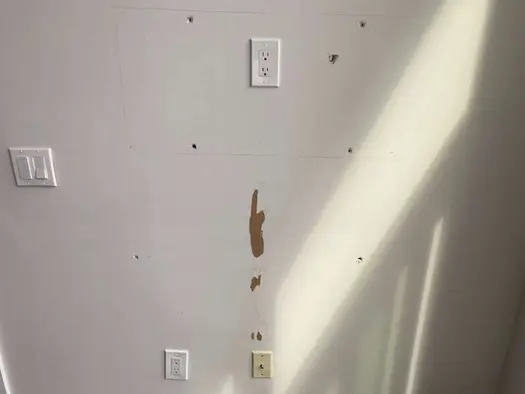
I'll be blunt about the shortcut people want. They want to spot-prime three patches and skip the rest because priming the whole wall feels like extra work. That shortcut is the number one reason I get called back to fix flashing. If the wall has real damage or a colour change, prime it wall to wall and you'll never see the repairs. Half-prime it and you'll see them every sunny afternoon. For patch and drywall correction done properly, see our drywall repair and painting service.
Fixing a bad paint job without repainting the whole wall
Usually not cleanly, and here's why. Walls are painted corner to corner so the sheen and roller texture stay uniform, and any localized fix tends to leave a footprint. Touch-ups commonly fail to blend because the patch paint cures to a slightly different sheen and texture than the aged surrounding film (PPG, 2025). For patchiness, roller marks, and flashing, recoat the whole wall.
There are narrow exceptions. A single drip you can shave with a blade and lightly sand, then touch in with paint from the same can using the same roller, feathered out. A small ding, same idea. But if the defect runs across the wall, like flashing or lap marks, a touch-up just stacks a new flaw on the old one. The repair patch reads as a slightly different sheen, so now you've got the original problem plus a touch-up halo.
My rule on a fix: the smallest unit you recoat is a whole wall, corner to corner, stopping at the natural breaks. It costs a little more paint and an hour more time, and it's the difference between a wall that looks fixed and a wall that looks patched. Cutting that corner to save half a can is exactly the thinking that caused the bad job in the first place.
Why a better paint won't fix a bad job by itself
Because prep and technique decide the outcome far more than the paint product does. A premium paint over an unprimed, patchy wall still flashes and still shows roller marks; a mid-grade paint over proper prep looks clean. In 20 years of correcting other people's work, surface preparation has decided the large majority of how a job performs, far more than the price of the can. The can can't sand your wall for you.
This is the part homeowners resist, because the paint aisle sells the opposite story. Buy the expensive line and your problems disappear, the marketing says. In 20 years I've never seen that hold. I've seen builder-grade paint over careful prep look better than top-shelf paint slapped on in one rushed coat over bare patches. The paint is maybe a quarter of the result. The other three-quarters is sanding, priming, wet edges, and two honest coats.
So buy decent paint, sure. Then spend your real effort where it counts. Sand the ridges and feather the patches. Prime the wall, not just the holes. Keep a wet edge and don't stop mid-wall. Do two even coats and let the first one dry before the second. Get those right with a middle-tier paint and you'll beat most of the bad jobs I'm called to fix. For more of these field-tested habits, see our painting tips from a real Toronto painter.
What's the right sequence to fix a bad paint job?
The fix sequence is the same one a good job follows, just starting from a damaged surface: sand, prime, then two even coats. Following a consistent prep-and-coat sequence is what separates durable finishes from quick re-dos, and in my experience skipped prep drives the bulk of the failures I'm called back to fix. Work the steps in order and the defects don't come back.
Here's the order I run on a correction, whether it's one feature wall or a whole condo somebody else botched.
- Diagnose in raking light. Name every defect on the wall before you touch it, so you prime and coat for the worst problem present.
- Sand to knock down texture. Flatten roller ridges, feather every drywall patch, and dull any glossy spots so the primer and topcoat can grip.
- Wipe the dust. A wall sanded and not wiped traps grit under the fix coats and reads like sandpaper. Vacuum, then wipe.
- Spot-prime or fully prime. Patches and stains always; the whole wall when there's a colour change, flashing, or many repairs. Tinted acrylic primer for porosity, stain-blocker for bleed-through.
- First full coat, wet edge held. Cut in, then roll wall to wall without stopping, right nap, light tip-off pass.
- Let it set, then second full coat. Wait the can's recoat time, longer in a cool Toronto basement, then repeat. Two coats is the floor.
That's the whole thing. No magic product, no one-coat shortcut. Just the steps the original job skipped, done in order. If you'd rather not give up a weekend sanding and priming somebody else's mistake, that's exactly the kind of work we take on as part of interior painting. And if your bad job is on a ceiling, the same logic applies, with a few twists covered in how to paint a ceiling properly.
Get a Toronto repaint or paint-fix quote
Twenty years fixing patchy walls, roller-marked feature walls, flashing that shows up at 4 p.m., and one-coat builder specials that never stood a chance. Every correction we do gets the same treatment: diagnose in raking light, sand and feather the damage, prime the wall properly, then two even coats with a wet edge held corner to corner.
Get your free paint-fix quote or call (416) 875-8706. Quotes inside 24 hours, fixed CAD pricing, HST disclosed.
We take on paint corrections as a standalone job or rolled into a full interior painting project, including the drywall repair that bad patches usually need underneath.
About the author
Chad Caglak is co-owner of HomePaintersPro Toronto and a 20-year working painter. He's painted and re-fixed everything from CityPlace condos to Leaside heritage homes, and writes the craft-and-pricing content here so Toronto homeowners can decide with real numbers instead of a guess. Read more from Chad in the Toronto painter craft hub or the wall prep checklist.
Frequently Asked Questions
Patchy coverage almost always means one thin coat over an uneven surface, or fresh patches that never got primed. Wall repairs, joint compound, and old glossy spots all drink paint at different rates, so a single coat dries blotchy with the old colour ghosting through. The fix is to sand the area smooth, spot-prime or fully prime the wall, then put on two even coats. No premium paint covers a patched or colour-changed wall properly in one coat, whatever the can promises.
Flashing is uneven sheen from the wall absorbing paint at different rates. Unprimed patches and spot-primed areas soak up more, so they dry duller or shinier than the rest, and side light from a window makes it obvious. In my experience uneven porosity from skipped or spot-only priming is the leading cause of flashing on a repaint. The fix is to prime the whole wall, not just the repairs, then apply two full even coats so the porosity is uniform across the surface.
Sometimes, but walls paint corner to corner for a reason. A single missed spot or a small drip you can sand and touch in, ideally with paint from the same can and the same roller. Patchy coverage, roller marks, lap marks, and flashing rarely touch up cleanly because the repair never matches the surrounding sheen and texture. For those, recoat the whole wall, edge to edge. Touch-ups on a flawed wall usually add a new flaw on top of the old one.
Roller marks and stipple show up when the nap was wrong, the paint was overworked, or the wet edge broke. PPG notes that rolling over half-dry paint and using the wrong nap are common causes of visible stipple and lap lines. Thick ridges come from too much paint and not tipping off; lap marks come from stopping mid-wall and letting an edge dry. The fix is to sand the ridges flat, then recoat the full wall with the right nap, a wet edge, and steady pressure.