








Paint finishes explained: a Toronto painter's room-by-room sheen guide
Key Takeaways
- MPI grades sheen at 60 degrees: G1 flat (0-5), G2 velvet-like flat (0-10), G3 eggshell (10-25), G4 satin (20-35), G5 semi-gloss (35-70), G6 gloss (70-85), G7 high gloss (85+) (MPI Architectural Painting Manual Guide Specification, April 2022)
- Bathroom ceilings and walls above the splash zone want Aura Bath & Spa matte, which carries both mildew and mold-resistant coatings on BM's 2026 spec
- Kitchen cabinets take Advance in satin. The walls above the backsplash take Aura Bath & Spa matte because the steam exposure is the same as a bathroom
- Higher sheen is not better quality. Sheen and durability are separate spec lines, and prep decides whether either one survives
- Plan two coats no matter the sheen or brand tier. BM's "1 or 2 coats" label is a hedge
In nearly every consultation the same thing happens: homeowners obsess over colour and treat sheen as an afterthought. Then they call me back six months later wondering why the kitchen walls look streaky or the bathroom ceiling is peeling. I've sprayed and brushed every sheen Benjamin Moore makes on interior painting Toronto jobs for 20 years. Aura matte on a Forest Hill living room. Advance satin on Leslieville cabinets. Aura Bath & Spa matte on more ensuite ceilings than I can count.
Sheen changes how the paint film survives steam, scrubbing, and Toronto's freeze-thaw cycle. Pick the wrong one and the best paint on the market will still fail. Pick the right one and a mid-tier product can last a decade. Here's the spectrum, sheen by sheen, with where each one actually belongs. For how sheen choices fit the wider job, see how residential painting work is scoped in Toronto.
Sheen is one decision and product line is another; for the second, see which Benjamin Moore line to choose.
What is paint sheen and why does the percentage matter?
Paint sheen is the amount of light a dried film reflects back at a 60-degree angle, graded by the Master Painters Institute on a seven-step scale from G1 flat to G7 high gloss (MPI Architectural Painting Manual Guide Specification, April 2022). That single number drives durability, washability, defect visibility, and how the room feels. A flat ceiling and a semi-gloss trim aren't only visual choices. They're chemically different paints.
The trade-off is mechanical. As sheen rises, the resin-to-pigment ratio shifts toward more resin and less pigment. More resin gives you a harder, glossier, scrub-resistant film. Less pigment means the paint hides imperfections less well, because light bounces off the surface instead of getting absorbed into the pigment matrix. You can have hide or you can have washability. Not both at maximum.
Paint sheen is measured as the percentage of light a dried film reflects at a 60-degree angle. The MPI tiers, measured at 60 degrees, run G1 flat (0-5), G2 a velvet-like flat (0-10), G3 eggshell (10-25), G4 satin (20-35), G5 semi-gloss (35-70), G6 gloss (70-85), and G7 high gloss (above 85). Higher sheen delivers better washability but exposes every surface flaw underneath (Chad Caglak, HomePaintersPro, 2026).
Every finish at a glance
| Finish | MPI grade | Sheen at 60° | Best for | Avoid on | Washability |
|---|---|---|---|---|---|
| Flat | G1 | 0 to 5% | Ceilings, low-traffic adult bedrooms, patched plaster | Kitchens, bathrooms, hallways, anything hands touch | Poor |
| Matte | G2 | 0 to 10% | Living rooms, primary bedrooms, older walls with wavy plaster | Kids' rooms, stairwells, splash zones | Poor to fair |
| Eggshell | G3 | 10 to 25% | Hallways, kids' rooms, family rooms, most Toronto walls | Ceilings, badly patched drywall | Fair to good |
| Satin | G4 | 20 to 35% | Kitchens, laundry, mudrooms, some trim | Large flat walls under raking light | Good |
| Pearl | not an MPI grade | between satin and semi-gloss | Kitchens that take real abuse, cabinet work | Anywhere you need hide | Very good |
| Semi-gloss | G5 | 35 to 70% | Trim, doors, casings, baseboards | Walls, ceilings | Excellent |
| Gloss and high gloss | G6, G7 | 70% and above | Feature doors, railings, high-wear metal | Almost every wall in a house | Excellent |
Two things that table will not tell you. Pearl is a manufacturer sheen name, not a grade, so it varies between brands in a way the MPI steps do not. And the "avoid on" column matters more in Toronto than the "best for" column, because our plaster walls and 1920s drywall punish high sheen harder than a new build ever would.
What does flat and matte paint actually do well?
Flat (0-5% sheen) and matte (5-10%) are the lowest-reflectivity finishes on the shelf, and they exist for one job: hiding imperfections on walls and ceilings (Sherwin-Williams sheen guide, retrieved 2026-05-26). Light scatters in every direction off the surface, which visually flattens bumps, patches, and drywall taping seams that any higher sheen would broadcast. On ceilings under raking light from a vanity or pot lights, matte is the one sheen that doesn't expose every defect.
The catch is that traditional flat paint cannot be washed without burnishing. That's the trade term for the glossy spot that shows up when you rub a flat surface too hard. Wipe a fingerprint off a builder flat ceiling and you'll leave a visible halo. Premium matte products like Aura and Regal Select solve this with resin chemistry. Aura's Color Lock binds pigment tight enough that you can scrub the wall with a Magic Eraser and it won't burnish. That's what the premium price buys on matte. Not better hide.
On a Roncesvalles dining room last year I sprayed Aura matte in a deep teal over builder flat. Two coats. About a year later the homeowner sent me a photo after their toddler decorated the wall with ketchup. A wet cloth lifted it clean. No burnishing, no ghosting. That's the gap between premium matte and budget matte, not a gap between matte and satin.
A powder room in Riverdale comes to mind too. The drywall under the vanity light had wave from a bad mud job the previous painter never sanded back. I talked the homeowner out of the satin she'd picked and put Aura Bath & Spa matte on the walls instead. The waves disappeared the moment the second coat dried. Satin would have lit every one of them up like a runway.
Best places for flat and matte:
- Ceilings throughout the home (Aura Bath & Spa matte for bathrooms, Aura matte or Ultra Spec ceiling paint elsewhere)
- Bedrooms and living rooms where you want sophisticated, light-absorbing depth
- Feature walls hiding old patch work
- Bathroom walls above the splash zone (Aura Bath & Spa matte specifically)
Before you settle on a sheen for a feature wall, it's worth deciding whether you want paint at all. A matte accent in a deep colour does a lot of the same work a feature wallpaper does, for a fraction of the long-term cost. If you're still weighing the two, our guide on paint vs wallpaper in Toronto lays out the cost and durability trade-offs.
When should you use eggshell, satin, and pearl?
Eggshell (10-25% sheen) and satin (20-35%) are the working sheens for rooms you actually live in. Pearl sits between satin and semi-gloss, and it is a manufacturer sheen name rather than an MPI grade, so you will not find it on the seven-step scale at all. They wash without burnishing, resist moisture better than matte, and still hide enough imperfection to look intentional on a real wall. Most of the Toronto interior jobs I quote land in this range somewhere.
Eggshell for hallways and kids' rooms
Eggshell is the lightest washable sheen. There's a barely-visible shimmer to it that reads almost matte from across the room, but it holds up to weekly wipe-downs. For hallways with backpack and scooter traffic, kids' bedrooms, and powder rooms with decent ventilation, eggshell is the practical default. Regal Select in eggshell is what I spec most often in this slot.
Satin for kitchens, family rooms, and trim
Satin is the workhorse. Daylight reflectivity is obvious, the wash performance is strong, and it shrugs off grease, splashes, and toddler chaos. For kitchen walls outside the immediate splash zone, family rooms with daily traffic, and most interior trim, satin is the modern standard. Advance satin is the cabinet pick. Regal Select satin handles the walls and trim.
Pearl for kitchens that take real abuse
Pearl sits between satin and semi-gloss. A bit shinier than satin, a bit more durable. For households that cook every day with high steam and grease, or for kitchens that haven't been deep cleaned in years, pearl gives you more washability headroom. Sherwin-Williams Cashmere pearl and BM Regal Select pearl both work here.
Eggshell, satin, and pearl finishes cover roughly 70% of residential interior sheen specifications in Toronto, with eggshell handling hallways and kids' rooms, satin owning kitchens and main trim, and pearl reserved for households that cook daily or need maximum wash durability without the plastic appearance of semi-gloss (Chad Caglak, HomePaintersPro, 2026).
What's the best paint for bathrooms and showers?
Benjamin Moore Aura Bath & Spa in matte is the right spec for almost every Toronto bathroom ceiling and wall surface, and the reason isn't aesthetic. On BM's current spec sheet, Bath & Spa is the only line that carries both mildew-resistant coating and mold-resistant coating as separately listed features, is Zero VOC, and asks for two coats with no "1 or 2" hedge (BM Aura Bath & Spa, retrieved 2026-05-26). At roughly $120 CAD per gallon, it costs the same as standard Aura but solves the steam problem any other matte fails on. For the full bathroom system, prep, ventilation, and ceilings, see our bathroom painting Toronto guide.
The counter-intuitive piece is the sheen. Most builders and big-box staff will tell you bathrooms need semi-gloss because shiny equals moisture-resistant. That was true 20 years ago. Modern resin chemistry changed the equation. Aura Bath & Spa's mildew-resistant additives are baked into a matte film that beats cheap semi-gloss against steam, because the additive is doing the work the sheen used to do. The matte finish also hides every drywall flaw that ensuite vanity lighting would otherwise expose under raking light.
The "bathrooms need semi-gloss" rule is decades old and ignores what current premium paints can do. Aura Bath & Spa in matte outperforms generic semi-gloss on mildew resistance and looks dramatically better on the wall. The reason builders still spec high-gloss bathrooms is cost. Bath & Spa runs $120 CAD a gallon. Commodity semi-gloss runs $40.
For shower enclosures, where the wall takes direct water spray, Bath & Spa in matte still holds, but I back it up with a bathroom-rated primer and confirm the substrate is sealed. Tile is still the call for the actual wet wall. Paint handles everything above the tile line.
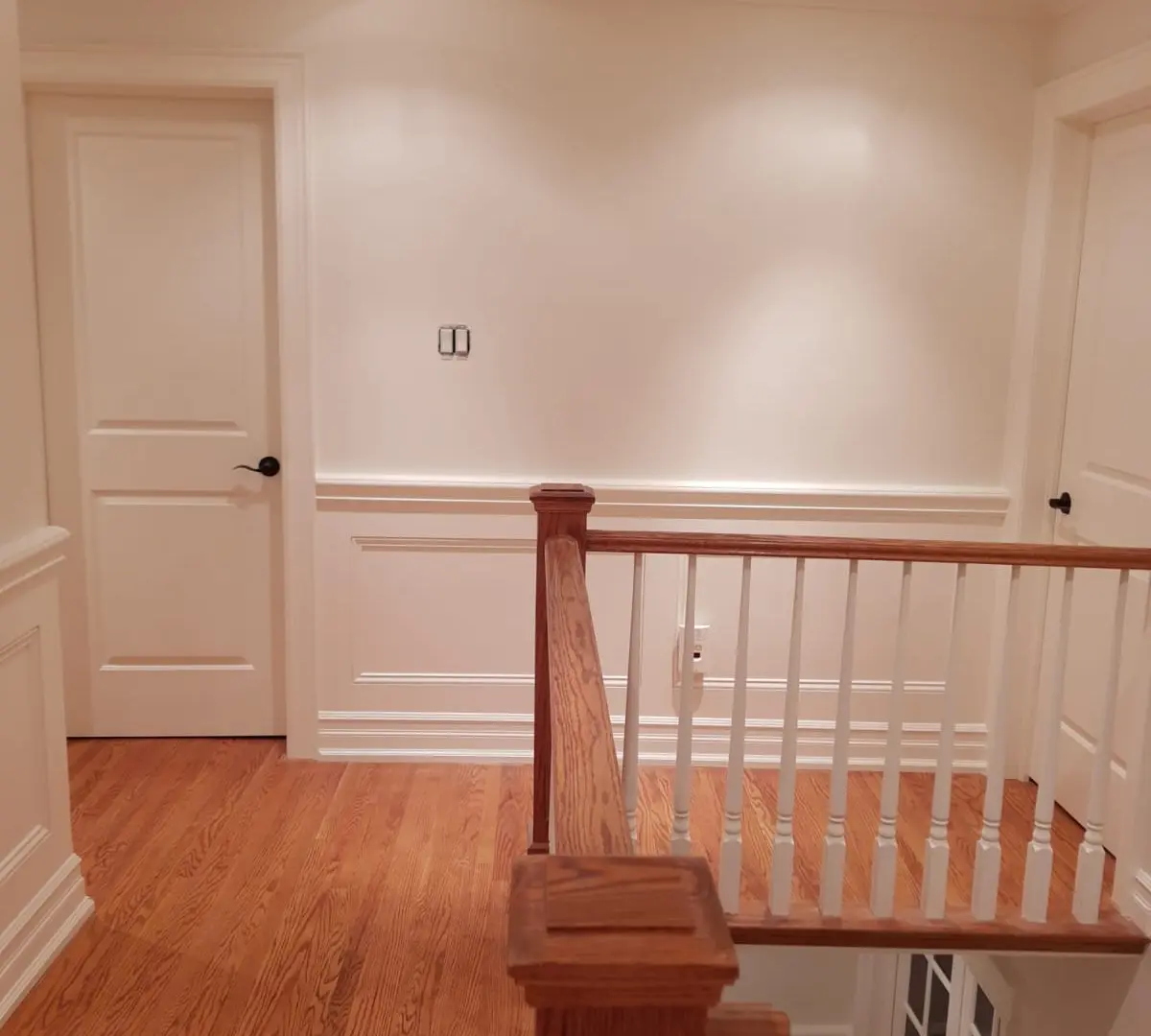
The rest of the room spec is on our bathroom painting page.
How do you spec a kitchen, splash zone included?
Kitchens are a two-product job in Toronto and there's no shortcut. Benjamin Moore Advance in satin on the cabinets, Aura Bath & Spa in matte on the wall directly above the splash zone. A big share of the kitchen repaint failures I'm called to inspect started with the wrong product on one of those two surfaces (Benjamin Moore Advance product page, retrieved 2026-05-26).
Cabinets: Advance in satin or pearl
Advance is a waterborne alkyd. That chemistry gives it the level-out of an oil paint with the cleanup of a latex. It dries hard enough to resist a fingernail dent, doors stop sticking to frames inside two weeks, and the satin sheen wipes clean of grease without going plastic-looking. Pearl is the second option if you want a touch more reflectivity. Semi-gloss on cabinets reads 1990s. Avoid it.
Walls above the splash zone: Aura Bath & Spa matte
This is the spec most painters get wrong. The wall directly behind the stove and above the counter takes the same steam, grease, and moisture exposure as a bathroom ceiling. Standard kitchen wall paint, even a premium satin, will yellow and trap grease film inside 2-3 years. Aura Bath & Spa matte was designed for the bathroom, but it's the right product on kitchen walls for the same reason: mildew resistance, washability, and a matte finish that hides drywall flaws.
I got called to a Junction Triangle kitchen two years after the previous painter rolled Regal Select satin on every wall. The wall behind the gas range had a yellow-brown halo about three feet wide that wouldn't come off with anything short of TSP and sanding. We re-primed the affected wall with Fresh Start, then rolled two coats of Aura Bath & Spa matte over the whole splash zone. Three years in, still clean.
The rest of the kitchen
Walls outside the splash zone can drop to Regal Select satin or eggshell depending on traffic. Trim and baseboards take satin in Regal Select or Advance. The ceiling takes Aura matte, or Aura Bath & Spa matte if the kitchen is enclosed and steam-heavy.
Toronto kitchens require a two-product specification: Benjamin Moore Advance in satin for cabinets (waterborne alkyd chemistry, dries hard, grease-resistant) and Aura Bath & Spa in matte for the wall directly above the stove and splash zone (mildew-resistant, Zero VOC, handles steam exposure). Standard satin wall paint yellows in this zone within 2-3 years (Chad Caglak, HomePaintersPro, 2026).
Cabinets get their own system, covered on our cabinet painting page.
Why do semi-gloss and gloss belong only on trim and doors?
Semi-gloss (40-70% sheen) and gloss (70%+) give you the most scrub resistance and moisture protection, but their reflectivity makes them visually wrong on any large wall surface in a home (Sherwin-Williams ProClassic gloss data, retrieved 2026-05-26). The same property that makes them durable, a hard resin film with low pigment density, also makes them broadcast every drywall taping defect under direct light. On trim, doors, and railings, they're the right call. On walls, they look plastic.
For exterior doors, gloss is the correct spec. Front doors take constant weather exposure, UV, freeze-thaw, and high-touch contact. Aura Grand Entrance in gloss or BM Command in gloss will hold up about a decade on a south-facing Toronto door. The reflectivity that would ruin a living room wall is exactly what you want on a door that needs to wash clean of road salt and shed rain.
One callback I remember well was a Cabbagetown semi where the previous painter sprayed the entire trim package in eggshell to match the wall sheen. Looked great on day one. Six months later every casing around the front entry was scuffed black from shoes and bag straps, and you couldn't wipe it without burnishing. We sanded, primed with STIX, and put two coats of Advance satin over the trim. The sheen mismatch with the eggshell walls disappeared once the trim read crisp again.
Best places for semi-gloss and gloss:
- Interior trim, baseboards, and door casings (semi-gloss if traditional, satin if modern)
- Interior doors (semi-gloss, sometimes pearl in newer homes)
- Exterior doors (gloss)
- Metal railings, ironwork, and shutters (gloss)
- Garage interior walls and concrete floors (semi-gloss with the right primer)
Why does sheen flashing happen and how do you prevent it?
Sheen flashing is the streaky, blotchy look that shows up after the paint dries when overlapping wet and dry brush or roller marks create different sheen reflections. It is one of the most common callbacks I get on residential repaints. The problem isn't the paint. It's the application technique and the prep underneath.
Three things cause flashing. First, breaking the wet edge. If you cut in a wall with a brush and let the brush band dry before rolling the field into it, the dry band picks up a different sheen than the wet-rolled centre. Fix: cut in one wall at a time, then roll into the wet brush band before it sets. Second, uneven absorption. Mud patches that weren't primed absorb topcoat at a different rate than the rest of the wall, leaving dull spots. Real primer on every patch handles that. Third, sheen mismatch between coats. First coat eggshell, second coat satin from a different can? You'll see it.
The flashing job I get called to fix the most is a homeowner who started a wall, took a 30-minute lunch break, came back, and picked up rolling where they left off. The dried wet edge from the morning leaves a vertical streak floor to ceiling. The only fix is rolling the whole wall again, corner to corner. No spot repair exists for flashing.
Most flashing starts at the prep stage, so it's worth reading how to prep a wall properly.
Why is two coats the baseline regardless of sheen or brand?
Benjamin Moore lists "1 or 2 coats" on every line in the catalogue from Aura down to Ultra Spec 500. The hedge doesn't reflect real-world conditions (BM technical data sheets, retrieved 2026-05-26). Over the chalky builder flat that most Toronto condos and new builds carry, even Aura's first coat soaks in unevenly. The colour reads close. The sheen reads blotchy. The film stays too thin to wash without burnishing. Plan two coats on every wall in every sheen, every time.
The mechanical reason has nothing to do with brand tier. Rollers skip. A brand-new microfiber sleeve loaded perfectly still leaves holiday lines where strokes overlap and stipple varies across a wall. You don't see the skips until the paint dries and light hits at an angle. The second coat fills the skips, evens the sheen, and gives you the uniform finish that one-coat rolling can't produce outside a spray booth.
It hits higher sheens harder. A skipped spot in matte hides under scattered light. A skipped spot in satin or pearl shows as a dull patch the first time direct sunlight crosses the wall. For semi-gloss trim, two coats is non-negotiable. Anyone quoting "one coat and done" in any sheen hasn't painted enough real walls. For pricing context on two-coat jobs, see our Toronto interior painting cost guide.
On a King West condo repaint I inherited, the previous painter quoted one coat of Aura at $0.55 CAD per square foot. Inside four months the homeowner had visible flashing on every wall. We came back, rolled a second coat over everything for another $0.45 per square foot, and the walls finally read uniform. Total cost ended up higher than if they'd specified two coats on day one.
Can you paint matte over a previously glossy surface?
Not without a bonding primer. "Self-priming" claims on the topcoat don't solve this (INSL-X STIX product specification, retrieved 2026-05-26). Matte topcoat rolled directly onto old oil-based semi-gloss trim or a glossy door will peel off in sheets inside a year. The new paint has nothing to grip.
The fix is INSL-X STIX or Benjamin Moore Stix waterborne bonding primer between the old gloss and the new matte. Apply STIX over the cleaned, lightly sanded glossy surface, let it cure, then roll your matte topcoat over it. The primer creates a mechanical bond to the gloss underneath and a chemical bond to the latex matte on top. Skip that intermediate layer and you're booking a failure for 12-18 months out.
This is the DIY failure I see most often when I'm called for paint inspection or rework in Toronto. Homeowners read "paint and primer in one" on the can and assume it means they can skip bonding primer. The label is talking about hide opacity over small patches, not adhesion to glossy substrates. New drywall, bare wood, water stains, and chalky or glossy surfaces all need real primer, no matter what topcoat you're using.
Should you put matte on exterior walls in Toronto?
No. Toronto averaged 61.9 observed freeze-thaw cycles per year over the 1971 to 2000 baseline (City of Toronto, Toronto's Current and Future Climate, Appendices, retrieved 2026), and exterior matte films lack the elasticity to survive that stress. Matte absorbs moisture, fails at the substrate bond, and starts peeling and chalking inside 2-3 seasons. For exterior wall surfaces in a Canadian climate I spec satin or higher, every time.
For exterior walls, BM Aura Exterior or Regal Select Exterior in low-lustre (the satin equivalent for exteriors) is the standard. Trim, doors, and shutters take semi-gloss or gloss. Freeze-thaw plus UV exposure rewards the same higher-sheen, higher-resin formulas that work for high-touch interior surfaces. The matte aesthetic conversation that drives interior choices doesn't transfer outdoors.
What's the simple sheen recommendation per room?
After 20 years of Toronto residential work, here's the room-by-room spec I default to.
- Bedrooms and living rooms: Aura or Regal Select in matte
- Hallways and kids' rooms: Regal Select in eggshell
- Bathroom ceilings and walls: Aura Bath & Spa in matte
- Kitchen cabinets: Advance in satin
- Kitchen walls above splash zone: Aura Bath & Spa in matte
- Kitchen walls outside splash zone: Regal Select in satin or eggshell
- Interior trim and baseboards: Regal Select or Advance in satin
- Interior doors: Advance in satin or semi-gloss
- Ceilings (non-bathroom): Aura or Ultra Spec ceiling paint in matte
- Exterior walls: Aura Exterior or Regal Select Exterior in low-lustre
- Exterior trim: Aura Grand Entrance or Command in semi-gloss
- Exterior doors: Aura Grand Entrance in gloss
Match the sheen to the moisture, traffic, and substrate exposure of each surface. Paint chemistry can solve most modern problems. Only if you spec the right product for the right job.
Need help spec'ing the right sheen?
Sheen selection is half the conversation. The other half is the prep, the primer choice, and the application technique that actually delivers what the can promises. We handle all three on every interior painting and bathroom painting job in Toronto: right product per surface, contractor pricing on Benjamin Moore, and a workmanship warranty on the finish.
For more on the products behind these recommendations, see our Aura vs Regal vs Ben vs Ultra Spec comparison, our paint colour selection guide, and our wall prep guide. When you're ready for a quote, request a free consultation and we'll spec sheen, product, and finish for every surface in your home.
About the author
Chad Caglak is co-owner of Home Painters Pro Toronto and a 20-year working painter. He's sprayed and brushed every sheen from flat ceilings to gloss doors across Forest Hill, Leslieville, and Riverdale homes, and writes the craft-and-pricing content here so Toronto homeowners can match the finish to the room instead of guessing at the paint counter. Read more in the Benjamin Moore line comparison or the wall prep checklist.
Frequently Asked Questions
Benjamin Moore Aura Bath & Spa in matte is the right call for almost every Toronto bathroom ceiling. It carries both mildew-resistant and mold-resistant coatings on BM's current spec sheet, is Zero VOC, and the matte sheen hides ceiling defects under raking light from vanity bulbs. At roughly $120 CAD per gallon and two coats required, it costs the same as standard Aura but solves the steam problem dedicated.
Benjamin Moore Advance in satin is the Toronto cabinet standard. It's a waterborne alkyd that levels like oil paint, dries hard enough to resist fingernail dents, and the satin sheen wipes clean of grease without the plastic look of semi-gloss. Pearl works too if you want slightly more shine. Skip semi-gloss on cabinets unless you want a 1990s appearance.
Premium matte like Aura or Regal Select holds up to scuff marks and gentle washing thanks to Color Lock resin and Stain Release Technology. Cheap matte burnishes (develops glossy spots) the moment you wipe it. If your hallway sees daily scooter and backpack traffic, step up to eggshell or pearl for a real durability gap, regardless of brand tier.
Not without bonding primer. Self-priming claims do not apply to glossy surfaces. You need INSL-X STIX or BM Stix between the old gloss and the new matte topcoat, or the new paint will peel off in sheets within a year. This is the single most common DIY failure I see on rework jobs across Toronto.