
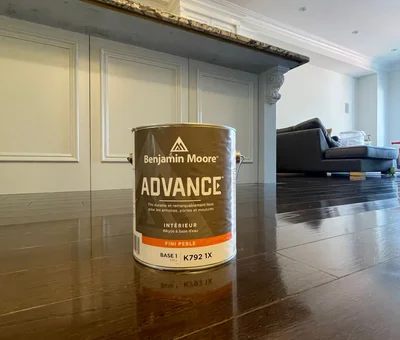




Advance vs Command vs Emerald Urethane vs Cabinet Coat: which one belongs on your kitchen?
Key Takeaways
- The number that decides your kitchen is cure time, and it is not on the front of any can. Benjamin Moore publishes up to 30 days to optimum hardness for Advance; Sherwin-Williams publishes no cure figure at all for Emerald Urethane
- INSL-X Cabinet Coat is the only one of the four rated by its own maker to go over melamine, Formica, polyurethane, and varnish with no primer
- Corotech Command is the only one publishing a numeric blocking figure (block-resistant in one hour) but it is a commercial Corotech maintenance coating, not a residential cabinet enamel, and carries roughly 3.4× Advance's VOC
- Zinsser's own data sheet tells you not to use TSP under B-I-N, which contradicts most cabinet-prep advice online
- Clean before you sand. INSL-X states it directly, and sanding a greasy door first drives kitchen grease into the substrate
Cabinet jobs do not usually fail in year three. They fail in month one.
The client gets the kitchen back, loads the shelves on day three because the doors feel dry, closes a door hard against the frame, and a week later there is a shiny mark where the paint pulled. Or the latch edge chips the first time someone opens it with a fingernail. Then everybody blames the paint.
Almost none of that is the paint. It is the gap between when a cabinet finish feels dry and when it is actually hard, and that gap is different for every product in this comparison, where the manufacturer publishes it at all. Primer chemistry decides much of the rest, and we take that apart separately in our primer comparison.
So this is a comparison of four cabinet coatings on the numbers that decide whether your kitchen survives its first month: Benjamin Moore Advance, Benjamin Moore Corotech Command, Sherwin-Williams Emerald Urethane Trim Enamel, and INSL-X Cabinet Coat.
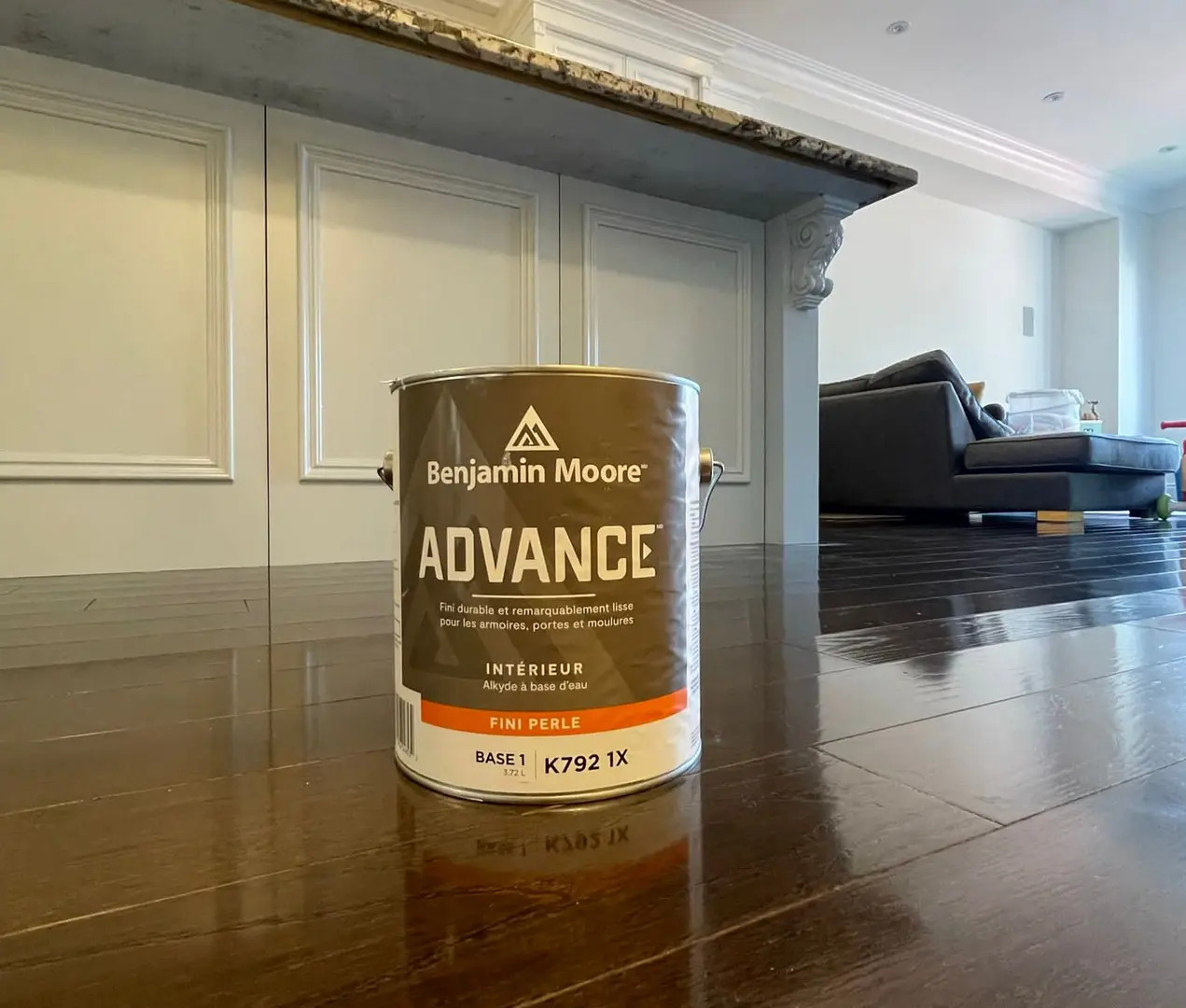
If you want the cost side rather than the product side, we have a separate breakdown of kitchen cabinet painting cost in Toronto by kitchen size. This one is about what goes in the gun.
The number nobody quotes you: cure time
Every paint has three or four times printed on the sheet, and homeowners plan around the wrong ones.
Dry to touch means the solvent has flashed off. Recoat means you can put the next coat on. Return to service means you can use the thing. Full cure means the film has reached its final hardness. On a wall, the distance between those is academic. On a cabinet door that gets closed against a frame forty times a day, it is the whole job.
The four manufacturers publish this:
| BM Advance 793 | Corotech Command V392 | SW Emerald Urethane | INSL-X Cabinet Coat | |
|---|---|---|---|---|
| Dry to touch | 4-6 hours | 15 minutes | 1 hour | 1 hour |
| Recoat | 16 hours | 1 hour | 4 hours | 6 hours |
| Block-resistant | claimed, no figure | 1 hour | claimed, no figure | no claim |
| Return to service | 5-7 days | 24 hours | not published | not published |
| Full cure | up to 30 days | not published | not published | 5-7 days (satin) / 14 days (semi-gloss) |
Sources: BM Advance 793 TDS (doc 793 US 070122); Corotech Command V392 Canadian TDS (doc M72 V392 CE 042925); SW Emerald Urethane semi-gloss PDS (101.010SGD, 03/2026); INSL-X Cabinet Coat satin CC-45XX Canadian TDS and semi-gloss CC-56XX TDS. Retrieved 2026-08-12.
Look at the last row. Two of the four do not publish a full cure time at all.
That is not me failing to find it. Sherwin-Williams' Emerald Urethane product data sheet, revised March 2026 and the freshest document in this whole comparison, publishes dry-to-touch and recoat and stops. Benjamin Moore does the same on Command, giving you return-to-service at 24 hours and no cure figure. Any "Emerald cures in 30 days" number you find online is not coming from the data sheet.
What this looks like on a real job: we spray a Toronto kitchen on a Thursday. The client texts Saturday because everything "feels dry" and asks if they can load the pantry. On Cabinet Coat satin I say the shelves can go back but be gentle for another few days. On Advance I say leave the shelves out until the middle of next week, and I mean it, because Benjamin Moore's own sheet asks for five to seven days before you put weight and abrasion on it. That conversation is easier when it happens at the quote instead of on the Saturday.
Benjamin Moore Advance: the best finish, on the longest clock
Advance is a waterborne alkyd. That is the whole story in two words. It flows and levels like an oil enamel because it chemically behaves like one, and it cleans up with water because it is waterborne. On a five-panel door, sprayed properly, it is the nicest finish of the four.
From the technical data sheet:
- Vehicle: waterborne alkyd
- VOC: 43.2 g/L, the lowest of the four
- Coverage: 400-500 sq ft per gallon, the highest of the four
- Dry to touch: 4-6 hours, recoat 16 hours
- Return to service: at least 5-7 days before heavy abrasion or returning shelves and tabletops
- Full hardness: up to 30 days to optimum hardness and final sheen
- Temperature: 50°F to 90°F surface
That 16-hour recoat is the working constraint people underestimate. Two coats is a two-day minimum, and there is no way to hurry it. Compare that to Command's one-hour recoat and you can see why a commercial crew doing a school over a long weekend does not reach for Advance.
Advance also has a prep instruction stated bluntly in its limitations: sand glossy alkyds before applying Advance. And for primer, the sheet routes MDF, thermofoil, and laminate to Fresh Start High-Hiding All-Purpose Primer 046. That detail is worth flagging, because Advance's own sheet is the only document in this entire comparison that names thermofoil explicitly. If you have thermofoil doors, Benjamin Moore has an answer in writing and the others do not.
Price: about $99.99 CAD per gallon at a Toronto-area BM dealer (Primetime Paint & Paper, retrieved 2026-08-12).
INSL-X Cabinet Coat: the one built for the job
Cabinet Coat is the only product here designed specifically for cabinets rather than adapted to them, and its adhesion claim is the boldest in the group. From the data sheet, verbatim: its superior adhesion allows painting difficult surfaces, even polyurethane and varnish, without using a primer. On melamine laminate or Formica, it says no primer needed, just a light sand with fine paper and a tack rag.
- Vehicle: urethane-reinforced acrylic, dries by coalescence
- VOC: 47 g/L satin, 44.5 g/L semi-gloss
- Coverage: 350-450 sq ft per gallon
- Tack free: 1 hour, recoat 6 hours
- Temperature: 10°C to 32.2°C, and not within 5° of the dew point
- MPI: #140 satin, #141 semi-gloss
There is one thing in the documentation worth surfacing rather than smoothing over. The two Cabinet Coat sheets do not agree on cure time. The Canadian satin sheet (CC-45XX, April 2017) says full cure in five to seven days. The US semi-gloss sheet (CC-56XX, May 2019) says 14 days. Same product family, different sheens, different documents, roughly a threefold difference.
Benjamin Moore's current catalogue also lists Cabinet Coat under newer product codes than either of those documents, so both sheets may have been superseded. If you are planning a kitchen around a cure date, ask the dealer to pull the current sheet for the exact sheen and code you are buying rather than trusting a number from a blog, including this one.
Cabinet Coat also warns about technique in a way the others do not: overworking it leads to brush or roller marks, because it dries quickly. It is the opposite personality to Advance. Advance rewards patience and punishes rushing the schedule; Cabinet Coat rewards a fast confident pass and punishes fussing.
Price: about $84.99 CAD per gallon, the cheapest of the four (Primetime Paint & Paper, retrieved 2026-08-12).
Sherwin-Williams Emerald Urethane Trim Enamel: excellent product, thin paperwork
Emerald Urethane is a urethane modified alkyd, which makes it chemistry-wise the closest relative to Advance in this group, not to Cabinet Coat or Command. It is a genuinely good trim and door enamel and plenty of Toronto shops spray cabinets with it.
- Vehicle: urethane modified alkyd
- VOC: under 50 g/L
- Coverage: 350-400 sq ft per gallon
- Dry to touch: 1 hour, recoat 4 hours
- Sheens: gloss, semi-gloss, satin
- Temperature: above 50°F (10°C)
- Canadian product series: K38Q
The four-hour recoat is a real practical advantage over Advance's sixteen. You can put two coats on in a day.
What I cannot tell you is when it is cured, because Sherwin-Williams does not say. The March 2026 product data sheet gives dry-to-touch and recoat and no cure figure, no return-to-service figure, and no numeric blocking figure. The consumer product page claims excellent blocking resistance; the technical sheet puts no number behind it.
There is a second documentation gap worth knowing about. Sherwin-Williams' published Residential Guide Specification contains no cabinet coating system at all. Its kitchen section specifies gypsum board walls and ceilings only, and the nearest system, for painted wood doors and trim, specifies PrepRite ProBlock primer with two coats of ProClassic rather than Emerald Urethane. In fairness that document dates from 2016 and predates SW's current Emerald cabinet marketing, so the honest reading is that SW's published residential spec has not been updated to cover cabinets, not that SW advises against it.
Price: Sherwin-Williams does not publish Canadian shelf pricing. It runs a company-store model with pro-account discounting, so the only real number is the one your local GTA store quotes you. Be wary of the US-dollar figures on comparison blogs; converting them is not the same as a Canadian price.
Benjamin Moore Command: fast, and not really a cabinet paint
This is the product most people asking about it have slightly wrong, including me until I read the sheet properly.
Command is not a residential cabinet enamel sitting beside Advance on the dealer shelf. It is part of Benjamin Moore's Corotech commercial line, and its Canadian data sheet describes it as being for light-to-moderate industrial, commercial, and select residential use. Cabinets appear in a substrate list that also includes handrails, shelving, floors, stairs, ramps, safety markers, curbs, and piping. Benjamin Moore launched it in March 2021 with facility maintenance and property management named as the target, positioning it as a single-component multi-substrate solution that lets painters work with speed.
Speed is exactly what it delivers:
- Vehicle: acrylic urethane, and it dries by evaporation rather than oxidation
- Tack free: 15 minutes
- Block-resistant: 1 hour, the only numeric blocking figure any of these four manufacturers publishes
- Recoat: 1 hour
- Return to service: 24 hours
- Temperature: 1.7°C to 37.8°C, relative humidity below 90%
- Interior and exterior, UV resistant
The drying mechanism explains the whole personality difference. Advance cures by alkyd oxidation, which is slow and keeps the film flowing so it levels beautifully. Command dries by evaporation, which is fast and stops the film flowing sooner.
The costs of that speed are real and you should weigh them:
- VOC 148 g/L, roughly 3.4 times Advance's 43.2. In an occupied Toronto condo with the family still living there, that is a genuine consideration
- Only two sheens, satin at 20-30 units and gloss at 80+. There is no semi-gloss, which is the sheen most cabinet clients actually ask for
- Its own sheet warns it may dry to an uneven finish on some species of wood
- Over existing glossy cabinets it is not self-priming: the sheet says degloss, and where you cannot, prime with a Corotech bonding primer
Price: about $109.99 CAD per gallon satin, $119.99 gloss, the most expensive of the four.
So why does Benjamin Moore sell both? Because they are aimed at different buyers. Advance is sold on finish quality to people repainting their own kitchen. Command is sold on schedule to people who need a building back in service tomorrow. Neither has replaced the other; both carry current data sheet revisions.
Where I would actually use Command in a house: the front door and the railings, not the kitchen. It is rated interior and exterior, it goes on down to 1.7°C, and it is back in service in 24 hours. On a Toronto entry door in October that combination is worth more than a semi-gloss option. Advance is interior only, so it is not even a candidate there.
That B-I-N bar is the point of the chart. Homeowners agonise over the VOC of the topcoat and then let someone spray a shellac primer at 550 g/L through the kitchen. If air quality is the concern in an occupied home, the primer decision matters more than the paint decision.
The prep that actually decides whether it holds
Product choice is maybe a third of a cabinet job. Here is the part that decides the rest, and two pieces of it contradict the standard internet advice.
Clean first, then sand. Not the other way around
INSL-X puts this in capitals on the Cabinet Coat sheet: always clean before sanding, to prevent driving contamination into the substrate or previous coatings. The same sequencing logic runs through all interior prep, set out in how to prep walls for painting.
Kitchen cabinet doors carry years of aerosolised cooking grease, concentrated worst around the stove and above the range hood. Sand that first and you drive it into the scratch pattern you just created, which is exactly where you then ask the primer to bond. The failure shows up months later as lifting or a soft, never-quite-hard finish over the doors nearest the stove. It is one of the most consistent patterns I see on rework.
Do not use TSP
This one surprises people, including painters. Zinsser's Canadian data sheet for B-I-N instructs you to wash the surface with a TSP-substitute prepaint cleaner, or an ammonia and water solution, or solvent, and puts "Do not use TSP" in the instruction itself.
Benjamin Moore does not recommend TSP either. Its own cabinet painting guide says to use a gentle grease remover and a damp sponge, and its technical route across the Advance, Command, and Cabinet Coat sheets is a dedicated oil and grease emulsifier product.
Most Toronto cabinet articles still tell readers to scrub with TSP. The manufacturers do not.
The primer decides more than the paint
| Your cabinets | Specified primer | Whose sheet says so |
|---|---|---|
| Thermofoil, MDF, or laminate | Fresh Start High-Hiding All-Purpose 046 | BM Advance 793 TDS |
| Melamine or Formica, under Cabinet Coat | None: light sand and tack rag | INSL-X Cabinet Coat TDS |
| Previously painted, sound | None needed with Cabinet Coat | INSL-X Cabinet Coat TDS |
| Glossy previously finished | Degloss, then STIX or B-I-N | INSL-X STIX; Zinsser B-I-N |
| Glossy, under Command | Degloss, or Corotech bonding primer | Corotech Command V392 TDS |
| Knots or tannin bleed | B-I-N shellac (mind the 550 g/L) | Zinsser B-I-N TDS |
| Interior wood, under Emerald | Premium Wall & Wood Primer | SW PDS 101.010SGD |
Two Benjamin Moore primer documents independently converge on the same warning, and it is the best evidence in this whole article for not rushing reassembly. STIX says to allow roughly three to four days to achieve maximum resistance to scrape off, even though you can topcoat it in three to four hours. Fresh Start 046 says that on hard, non-porous surfaces, maximum adhesion and hardness may take three to four days to develop.
Topcoatable in hours. Not scrape-resistant for days. That gap is precisely why cabinet doors chip at the latch edge on jobs that went back together too fast.
Spray or brush, and what the sheets say about it
Doors come off, hardware comes off, everything gets labelled. That part is not controversial. If the existing finish is old oil-based enamel, test before you sand, because telling oil from latex takes two minutes and changes the prep. What the manufacturers say about method is more specific than most people realise:
| Product | Airless | HVLP | Thinning |
|---|---|---|---|
| Advance 793 | 1,500-2,500 PSI, tip .011-.015 | 20 PSI, 1.8 tip, add 4 fl oz water/gal | Unnecessary; max 8 fl oz/gal |
| Emerald Urethane | 2,000 PSI, tip .013-.017 | Graco HVLP 9.5, #3 or #4 needle | No reduction needed |
| Cabinet Coat (CE satin) | Tip .019-.021, pressure as low as possible | Preferred method, #12 air cap | Up to 236 mL per 3.79 L |
| Command V392 | 1,500-2,500 PSI, tip .013-.017 | Not specified | No reduction necessary |
INSL-X is the only one of the four that names a preferred spray method, and it names HVLP. Advance is the only one that tells you to add water specifically for HVLP. The Cabinet Coat Canadian sheet also explains why it wants low airless pressure and a bigger orifice: atomisation can infuse the product with air that becomes entrapped in the coating, and multiple thin coats beat one heavy application.
One caution if you are sourcing your own specs: Cabinet Coat's two data sheets give quite different airless tip sizes (.019-.021 on the 2017 Canadian satin sheet against .011-.015 on the 2019 US semi-gloss sheet). Use the sheet that matches the can in your hand.
For the wider method question across walls, trim, and cabinets, we have a full breakdown of spray vs roll vs brush in Toronto homes. Condo kitchens are their own case because the doors are usually thermofoil rather than wood: see painting condo kitchen cabinets.
So which one goes on your kitchen?
INSL-X Cabinet Coat is my default on Toronto cabinet jobs. It is purpose-built, it is the cheapest of the four, it is the only one rated by its maker to go over melamine, Formica, polyurethane, and varnish without primer, and its cure window is workable for a family that needs the kitchen. Spray it HVLP, do not overwork it, and confirm the cure figure on the current sheet for your sheen.
Benjamin Moore Advance when the finish is the priority and the schedule is genuinely flexible. Best levelling of the four, lowest VOC, best coverage, and the only sheet that names thermofoil. You are paying for it in time: 16-hour recoat, five to seven days before shelves go back, up to 30 days to full hardness. In an empty house before a move-in, that is free. In an occupied family kitchen, it is not.
Sherwin-Williams Emerald Urethane if you are already a Sherwin-Williams shop or you have a pro account that makes the pricing work. Good enamel, four-hour recoat, three sheens. Accept that you are working without a published cure time and build your own buffer.
Benjamin Moore Command for the fast commercial-style turnaround, rental units, or a landlord who needs the unit back. Also genuinely good on the front door and railings, where its exterior rating and 1.7°C floor matter. Not my pick for a family kitchen: no semi-gloss, 148 g/L, and a data sheet that warns about uneven finish on some woods.
The part that outranks all four: the painter matters more than the can. Doors off, hardware off and bagged, degreased before sanding, sanded to the grit the sheet asks for, primed where the substrate needs it, sprayed flat, and left alone long enough to harden. Do all that with the cheapest product here and it will outlast a rushed job in the most expensive one. I have gone behind jobs sprayed in excellent paint that failed in a year because the doors went back on the boxes in 48 hours.
If you would rather not referee four data sheets, that is what the quote is for. I will look at your doors, tell you what they are actually made of, which primer that substrate needs, and how many days your kitchen will genuinely be out of service, before you commit to anything.
Call me directly at (416) 875-8706 or request your free quote. If I am spraying when you call, I will get back to you the same day.
We run cabinet doors through an off-site spray setup rather than tenting your kitchen, which is how cabinet painting gets a factory-grade finish without a week of dust in the house. Doing the kitchen walls and trim at the same time is almost always cheaper than two separate bookings.
Bottom line for Toronto homeowners
| Your situation | What I would spec | Why |
|---|---|---|
| Family kitchen, need it back this week | INSL-X Cabinet Coat | Workable cure window; self-priming over sound existing finishes |
| Empty house before move-in | BM Advance | Best levelling of the four, and you can afford the 30-day hardening clock |
| Thermofoil or laminate doors | Fresh Start 046 primer, then Advance | Advance's sheet is the only one that names thermofoil in writing |
| Melamine or Formica doors | Cabinet Coat, no primer | Its own sheet calls for a light sand and tack rag only |
| Occupied condo, air quality a concern | Cabinet Coat or Advance; avoid shellac primer | 43-47 g/L topcoats, and B-I-N at 550 g/L is what you would actually smell |
| Rental turnover, unit needed tomorrow | Corotech Command | 1-hour block resistance and 24-hour return to service, published |
| Oak with heavy grain or tannin risk | Fresh Start 046 or a shellac spot-prime, then topcoat | Open grain and tannin are a primer problem, not a topcoat problem |
| Front door and railings | Corotech Command | Interior/exterior rated down to 1.7°C; Advance is interior only |
The thread through every row: pick for the substrate you have and the schedule you can actually keep. The finish quality difference between these four is smaller than the difference between a kitchen that got its cure time and one that did not.
About the author
Chad Caglak is the co-owner and lead painter at HomePaintersPro, a Toronto-based residential painting company. He has spent more than 20 years refinishing Toronto kitchens, from thermofoil condo galleys in Liberty Village to solid oak in Lawrence Park, and runs an off-site spray shop so cabinet doors are finished flat and dust-free rather than tented in a client's kitchen. His work covers waterborne alkyd and acrylic urethane enamels, bonding primer specification, degreasing and substrate prep, and HVLP and airless finishing.
He writes about Toronto painting from the shop floor, not from a marketing desk. Every specification in this guide comes from the manufacturer's own technical data sheet with the document revision code checked, and where a manufacturer does not publish a figure, this article says so instead of estimating one.
Knows about: kitchen cabinet refinishing, waterborne alkyd and acrylic urethane enamels, bonding primer specification, HVLP and airless spray finishing, Toronto residential painting.
Frequently Asked Questions
For most Toronto kitchens I spray INSL-X Cabinet Coat or Benjamin Moore Advance, and the choice between them comes down to how fast you need the kitchen back. Cabinet Coat is a urethane-reinforced acrylic that its own data sheet says will bond to difficult surfaces including polyurethane and varnish without a primer, and it publishes a five to seven day full cure for the satin. Advance is a waterborne alkyd that levels better than anything else in this group, but Benjamin Moore states it can take up to 30 days to reach optimum hardness and final sheen, and asks you not to return shelves and tabletops to service for five to seven days. Neither is wrong. One is a finish decision and the other is a scheduling decision, and most homeowners are never told the difference exists.
Benjamin Moore''s own technical data sheet for Advance semi-gloss 793 puts it in the limitations section: it could take up to 30 days to reach optimum hardness and final sheen. The same sheet says to wait at least five to seven days before heavy abrasion or returning shelves and tabletops to service. Dry to touch is four to six hours and recoat is 16 hours. Those first two numbers are the ones people plan around, and they are not the ones that matter. A cabinet door that feels dry on day two will still mark if you bang a pot into it, and doors closed hard against frames before the film has hardened are how blocking starts. If you have a family of four who need the kitchen back this week, Advance is the wrong specification no matter how good it looks.
It depends entirely on which product you chose and what your cabinets are made of. INSL-X Cabinet Coat is the only one of these four whose own data sheet says no primer is needed over melamine laminate or Formica, just a light sand and a tack rag, and none over previously painted surfaces in good condition. Benjamin Moore''s Advance sheet takes the opposite position and routes MDF, thermofoil, and laminate to Fresh Start High-Hiding All-Purpose Primer 046. Corotech Command tells you to degloss, and where you cannot degloss properly, to prime with Corotech Waterborne Bonding Primer. So Cabinet Coat is self-priming by specification, Advance is not, and Command is conditional. Read the sheet for the can you actually bought.
Zinsser says explicitly not to, and that surprises most people. The Canadian technical data sheet for B-I-N instructs you to wash the surface with a TSP substitute cleaner or an ammonia and water solution or solvent, and puts "Do not use TSP" in the instruction itself. Benjamin Moore''s own cabinet guide does not mention TSP either; it says to use a gentle grease remover and a damp sponge, and its technical route is a dedicated oil and grease emulsifier. There is a sequencing rule that matters just as much, and INSL-X states it plainly on the Cabinet Coat sheet: always clean before sanding, to avoid driving kitchen grease down into the substrate and the old coating. Sanding a greasy door first is one of the most common reasons a cabinet finish lifts months later.
No, and it is not really a residential cabinet paint at all. Command is part of Benjamin Moore''s Corotech commercial line, and its Canadian data sheet describes it as being for light-to-moderate industrial, commercial, and select residential use. Cabinets appear in a substrate list that also includes handrails, stairs, ramps, curbs, and piping. Both products remain in Benjamin Moore''s current catalogue with recent data sheet revisions, so Command has not superseded anything. What Command does offer is speed, and it is the only one of these four that publishes a numeric blocking figure: block-resistant in one hour, return to service in 24 hours. The trade-offs are real too: only two sheens, roughly three and a half times the VOC of Advance, and a data sheet note that it may dry to an uneven finish on some species of wood.
That is called blocking, and it happens when a paint film is closed against another surface before it has hardened enough to resist it. It is not a defect in the paint, it is a schedule problem. Three of these four manufacturers claim block resistance without publishing any number for it. Only Corotech Command puts a figure on the sheet, at one hour. For everything else you have to work from the cure guidance instead: Benjamin Moore asks for five to seven days before returning shelves and tabletops to service on Advance and notes up to 30 days to optimum hardness. The practical fix on a job is to leave doors off the boxes as long as the client can tolerate it, and when they go back on, put small felt bumpers at the contact points for the first month.
At a Toronto-area Benjamin Moore dealer in August 2026, INSL-X Cabinet Coat runs about $84.99 CAD per gallon, Benjamin Moore Advance about $99.99, and Corotech Command about $109.99 for satin and $119.99 for gloss. Sherwin-Williams does not publish Canadian shelf pricing online at all; it is a company-store model with pro-account discounting, so the only way to get a real Emerald Urethane number is to phone a GTA store and ask. Be careful with the US dollar figures that circulate on comparison blogs, because converting them is not the same as a Canadian quote. Material is also the small half of a cabinet job: on a typical Toronto kitchen, paint is a few hundred dollars against labour and prep that run into the thousands.
You can, and with Advance you can get surprisingly close, because its long open time is exactly what lets an alkyd level out brush marks. Cabinet Coat is less forgiving and says so on its own sheet: overworking it leads to brush and roller marks because it dries quickly. If you are spraying, the sheets are specific and worth following. INSL-X is the only one of the four that names a preferred method, and it names HVLP. Advance is the only one that tells you to add water specifically for HVLP, at four fluid ounces per gallon. Emerald Urethane and Command both say no reduction is needed. Whatever the method, doors come off, hardware comes off, and everything gets labelled, because the finish quality difference on a panelled door comes from spraying it flat, not from the gun.