





Benjamin Moore Aura vs Regal vs Ben vs Ultra Spec — which line belongs on your wall?
Key Takeaways
- Aura at ~$120/gallon CAD still needs two coats over builder-grade flat to deliver its full depth, washability, and Color Lock durability
- Regal Select at ~$100/gallon is the default pro pick: self-levels on trim, washes without burnishing, includes Stain Release Technology, and outlasts Ben by 3-5 years on high-traffic walls
- Ben at ~$80/gallon is now BM's only Zero VOC line per 2026 specs, the strongest air-quality pick on paper, though it lacks mildew resistance and shows more roller texture
- Ultra Spec 500 at ~$55/gallon is MPI-approved and LEED v4 eligible: a legitimate choice for low-traffic adult households and ceilings, not just contractor work
- For bathrooms and showers, Aura Bath & Spa ($120/gal) is built for high-humidity rooms with mildew resistance and a matte finish
I've used all four of these on Toronto jobs, sometimes all four in the same house. Aura on a deep navy feature wall in a Forest Hill living room. Regal Select on the trim and built-ins. Ben in the secondary bedrooms upstairs. Ultra Spec on the ceilings and the basement.
Benjamin Moore sells these as one product family with one logo, but they're four different paints under the lid. The chemistry isn't the same. The resins aren't the same. The VOC profiles aren't either. Most homeowners overspend on BM because they walk into a dealer, ask for "Benjamin Moore," and get sold Aura when Regal would've done the job. Or they cheap out and buy Ben when Aura was the one product that mattered.
I'll walk through what each line is for, where the line draws between them, and which one I'd put on your wall.
Don't want to spec paint yourself? That's what we handle on every interior painting and condo painting job. Right product per surface, contractor pricing (20-40% below retail), lifetime workmanship warranty.
How much does each Benjamin Moore line cost in Toronto?
Benjamin Moore sets US pricing and Canadian dealers mark up 15-30% on top (Prudent Reviews, 2025). That means the same gallon of Regal Select can swing $15-20 between two dealers within a 30-minute drive of each other. Here's what you'll pay walking into a Toronto dealer in 2026:
| Line | Tier | Price/Gal (CAD) | Best For |
|---|---|---|---|
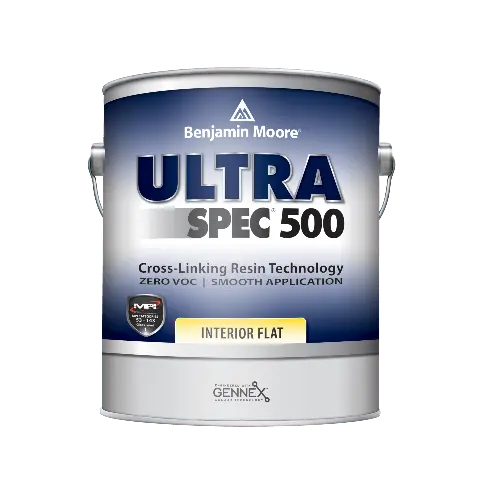
| Ultra Spec 500 | Contractor | ~$55 | Ceilings, basements, rentals, commercial |
| Ben | Entry residential | ~$80 | Secondary bedrooms, low-traffic walls |
| Regal Select | Mid-premium | ~$100 | Main living areas, trim, kids rooms |
| Aura | Premium | ~$120 | Accent walls, dark colours, allergy homes |
The Ultra Spec 500 number throws people off. Most homeowners assume BM is "premium only" and forget that Benjamin Moore has sold commercial-grade contractor paint for decades. A 5-gallon pail of Ultra Spec runs about $215, under $11 per litre. That's competitive with Behr and Beauti-Tone at Home Depot.
One pricing detail every dealer leaves off the sticker: deep, saturated colours cost up to $7 extra per gallon across every BM line. The reason is mechanical. Dark colours need a different "deep base" that holds less white tint, leaving room for more colourant. The base itself costs more to produce, and the dealer passes that through. So a gallon of Aura in a soft off-white sits at $120, but the same Aura in a deep navy or burgundy can ring up at $125 to $127. Multiply that across a full home repaint and the budget creep adds up fast. If your dealer quotes you a flat per-gallon price, ask what base it's mixed in (pastel, medium, or deep) before you commit.
The $40 spread between Regal Select and Aura is what causes most of the second-guessing at the dealer counter. Is the extra cost worth it? Depends on your colour.
What I usually spec: Regal Select is the default on 80% of our residential jobs. Aura comes out for accent walls, deep colours, and homes with kids who have asthma. Ultra Spec is my go-to for ceilings on every job. It saves the client $200-400 in paint they don't need on a surface no one touches.
Does Aura really cover in one coat?
Short answer: only in lab conditions, and even then there's a catch. Aura's one-coat claim assumes you're rolling over a properly primed, uniform surface, which almost no real Toronto home has (Benjamin Moore Aura technical data, 2025). Over builder-grade flat paint, and that's 90% of Toronto condos and new builds, Aura still needs two coats to deliver the depth, sheen uniformity, and durability you're paying for. One pass might look close on the day, but you're leaving the real benefits on the table.
There's a mechanical problem the spec sheet doesn't mention. Even if the chemistry can hide in one coat, the application can't. Rollers skip. Even a brand-new microfiber sleeve loaded perfectly leaves thin spots, holiday lines where strokes overlap unevenly, and stipple variation across the wall. You don't see the skips until the paint dries and the light hits the wall at an angle. By then the only fix is a second coat. That second coat fills the skips, evens the sheen, and gives you a uniform finish that one-coat rolling physically cannot produce outside a spray booth. Anyone telling you otherwise hasn't rolled paint under raking light from a low-angle window.
What happens on real jobs: Over the chalky builder flat that GTA developers use, even Aura's first coat soaks in unevenly. The colour reads close, but the sheen is blotchy and the film is too thin to wash without burnishing. Two coats gets you the real Aura: the depth, the washability, the 10-year wall. Anyone telling you "one coat and walk" on a residential wall hasn't painted enough of them.
Where the one-coat claim does hold up: when you're recoating with the exact same paint line and the exact same colour already on the wall. Touch-ups. Refreshing your own existing Aura job in Hale Navy with another can of Aura in Hale Navy. In that narrow scenario, yes, one pass and done. Any other situation (new colour, different brand underneath, builder flat, contractor-grade primer), plan on two coats. That isn't a Benjamin Moore weakness. It's how every paint works on a real wall.
Regal Select needs two coats, every time. Ben too. Ultra Spec usually needs two coats on flat walls, sometimes one on ceilings if you're going white-over-white. Before anyone points to the BM spec sheet: yes, Benjamin Moore officially lists "1 or 2 coats" for all four lines, not just Aura (BM product spec sheets, retrieved 2026-05-26). That hedge applies to the entire lineup. Plan two for every line and you won't have to redo a wall.
One more myth worth killing: "paint and primer in one." If every line in the catalogue claims it, the label means nothing. Aura, Regal Select, Ben, and Ultra Spec 500 all read "Self Priming" on BM's current spec sheets. That label does not mean you can skip priming new drywall, bare wood, stained surfaces, or major patch repairs. What "self-priming" actually refers to is hide: enough opacity to cover small filler spots and skim-coat patches without them telegraphing through the final coat. Coverage, not primer. For new drywall, water stains, smoke damage, raw wood, dark colour changes, or anything bare, you still need a real primer. Zinsser BIN for stains, BM Fresh Start for drywall. Skip that step and you'll see flashing, uneven sheen, and patches bleeding through within weeks.
Once you factor in two coats across all four lines (the real-world scenario over builder paint), the cost per square foot tells a clearer story:
Aura is genuinely the most expensive line per square foot when you paint it properly. Two coats over builder flat puts it at roughly $0.64/sqft against Regal at $0.50. What you're paying for is the colour depth and the Color Lock washability, not a one-coat shortcut.
Real job last month: Bloor West Village living room, 14×16, accent wall in Dragon's Breath (a deep burgundy) over builder-grade flat. Two coats of Aura, one gallon, $120 in paint. Same wall in Regal Select would've needed two coats plus a tinted primer to hit the same depth, so roughly $130 in paint and an extra prep day. Aura still won on total cost and finish quality, but not because of any one-coat magic.
How durable is each line on real walls?
On spec sheets, Aura claims 10-12 years on bedroom and living room walls, Regal Select 8-10, Ben 5-7, and Ultra Spec 500 in flat around 3-5. Those numbers compress a lot in practice. How long paint lasts comes down to how the wall gets treated, not which can it came from. Kitchens and bathrooms cut every line's lifespan in half from moisture, grease, and constant wiping, no matter how premium the paint is.
Ultra Spec held up better than I expected: Last year I went back to a Yorkville condo I'd painted six years earlier in Ultra Spec 500. The client wanted a colour change, not a repair. Walls were still flat, even, clean. No chalking, no scuff marks worth mentioning. This was Ultra Spec, the "budget contractor line." The difference wasn't the paint. It was the client. Clean lifestyle, no kids, no pets, dusted the walls occasionally with a microfiber. Compare that to a Ben job I did in a family home with two toddlers. Three years in and there's marker, food, and shoe scuffs on every wall in the house. Maintenance and household traffic matter more than the paint tier.
The flip side: there are environments where even the best paint can't survive. Nicotine from indoor smoking stains and yellows every line in this lineup within 1-2 years, Aura included. Same with frequent candle burning, especially scented or paraffin candles. They deposit a fine soot film on walls and ceilings that no paint formula can shrug off. By year two of a heavy candle-burning household, ceilings turn grey-yellow and corners go black. Premium paint doesn't save you from that. Only ventilation, an air purifier, or quitting the habit does. Once nicotine or smoke has worked into the paint, you can't wash it out. You have to prime with a shellac-based stain blocker like Zinsser BIN and repaint. That's a $3,000 to $8,000 condo repaint that good airflow would have prevented.
Aura's washability is the spec sheet headline and the real reason to pay the premium. You can scrub it with a Magic Eraser, hit it with degreaser, take a wet cloth to crayon marks, and the paint holds. The Color Lock resin binds tight enough that the surface doesn't burnish (that glossy spot that shows up when you wash flat paint too hard). This is what Aura buys you that no other BM line matches. Not the marketing one-coat claim. Not the colourant system either, since Gennex is on every BM line now.
Regal Select self-levels better than anything else in the lineup. Brush marks disappear as the paint dries. On trim, doors, and built-ins where you're laying down 6-foot strokes, that self-leveling is what separates a $100 paint job from a $5,000 one. BM's current Regal Select spec sheet also lists a Stain Release Technology that lets you wipe off common household stains (coffee, ketchup, marker) without burnishing or pulling colour off the wall (Benjamin Moore Regal Select, retrieved 2026-05-26). That's why I'll often spec Regal in the kitchen. It cleans well, and the trim still looks crisp five years in.
For bathrooms specifically, both standard Aura and Regal Select have mildew resistance listed on their current spec sheets, so either will hold up in a powder room or low-humidity bathroom. For ensuites with daily shower steam, basement bathrooms, or anywhere condensation pools, step up to Aura Bath & Spa. Per BM's current spec sheet, Bath & Spa carries both mildew-resistant and mold-resistant coatings as separate listed features, is Zero VOC (lower than standard Aura's <50 g/L), and BM explicitly recommends 2 coats. No "1 or 2" hedge. They're telling you straight up to do two. At roughly the same ~$120 CAD dealer price as standard Aura, there's no price premium for the bathroom-specific formulation, so just spec it for any room with daily moisture (Aura Bath & Spa product page, retrieved 2026-05-26). The matte finish looks nothing like the chalky high-gloss most builders use in bathrooms. For a shower enclosure, this is the only line I'd spec. For the full bathroom system, prep, ventilation, ceilings, and cost, see our bathroom painting Toronto guide.
Ben is fine. That's the most honest review I can give it. It rolls smooth, dries reasonably uniform, and holds colour. Where you'll notice it failing is on inspection. At arm's length you'll see slight roller stippling that Regal would've hidden. For a kid's bedroom that's getting repainted in three years anyway, that isn't a dealbreaker.
Ultra Spec 500 was originally built as a fast-applying contractor paint for ceilings, closets, garage interiors, basement walls, rental turnovers, and commercial work. The conventional wisdom says it doesn't belong on high-traffic residential walls, and on paper that's true. In a busy family home with kids, pets, and weekly grease splatter from cooking, Ultra Spec will show wear faster than Regal Select or Aura. But in a quiet adult household where the walls don't get abused, Ultra Spec can look great years later. The paint isn't the limiting factor. The lifestyle is.
Interior paint returns roughly 107% ROI and 80% of agents say fresh paint positively impacts a sale (HomeLight, 2023). That ROI holds regardless of which line you used, as long as the walls still look clean and even when buyers walk through.
For sheen selection, here's our paint finishes guide. Sheen often matters more than line for high-traffic surfaces.
Why does my paint have a dark frame around the edges? (Boxing / picture-framing defect)
Picture-framing, called "boxing" in the trade, shows up on roughly 1 in 4 residential repaint jobs we audit in Toronto, and it has nothing to do with which Benjamin Moore line was used. The defect appears within 6-12 months as a visible dark frame around every wall: thicker, darker paint along the cut-in edges, washed-out paint in the rolled centre. The cause is application technique, not paint chemistry (Painting and Decorating Contractors of America technique guidance, 2024).
[INTERNAL-LINK: cutting in twice -> /blogs/how-to-prep-walls-for-painting/]
Here's the mechanical reason. A painter cuts in the perimeter with a brush (corners, ceiling line, around trim and outlets), then rolls the field of the wall. If they cut in once and roll once, the perimeter ends up with two coats of paint (brush plus roller overlap), but the rolled middle only carries a single coat. The day the job finishes, both zones look identical. Within a year, the single-coat middle thins, fades, and burnishes faster than the double-coat perimeter. A dark "picture frame" appears on every wall in the house.
Why every BM line is equally vulnerable
Boxing is a film-thickness defect, not a product defect. Aura at $120/gal will frame just as visibly as Ultra Spec 500 at $55/gal if the painter only rolls one coat over the cut-in. The Color Lock resin in Aura cannot compensate for missing film thickness. Same logic applies to Regal Select's Stain Release and Ben's Zero VOC formula. Paint chemistry can't fix what application leaves behind (Benjamin Moore application guidance, retrieved 2026-05-26).
How a proper two-coat sequence prevents it
The fix takes about 20% more time. Cut in the perimeter with a brush. Roll the first full coat across the entire wall, working the roller into the wet cut-in band so the brush marks and roller stipple blend. Let it dry. Cut in again. Roll the second full coat. Now every square inch of the wall carries two coats, including under the cut-in. Boxing cannot appear because no zone is film-starved.
[CITATION CAPSULE: Picture-framing (boxing) is an application defect where a dark frame appears around walls 6-12 months after painting because the cut-in perimeter received two coats (brush plus roller) while the rolled centre received only one. The fix is two full cut-ins and two full roller coats, regardless of which Benjamin Moore line is used (Chad Caglak, HomePaintersPro, 2026).]
A one-year-old paint job with no boxing is one of the fastest visual proofs that a painter knows the trade. If a quote comes in 30% cheaper than the others, ask explicitly: "Are you cutting in twice and rolling twice?" If the answer is "we cut in once and roll once, that's industry standard," walk away.
Why does the same Benjamin Moore colour look different on different walls? (The 27-door tint formula story)
Benjamin Moore revises its colour formulas periodically and pushes the updates to dealer tinting computers on a rolling basis, not all at once. That means two dealers within a 30-minute drive can mix the same colour code into the same product line and produce visibly different paint on the wall. Roughly 5-8% of touch-up jobs we audit show a measurable colour shift traceable to this exact issue (Benjamin Moore Color Portfolio technical documentation, retrieved 2026-05-26).
What happened on the 27-door Lawrence Park job
[PERSONAL EXPERIENCE] We were spraying 27 interior doors in a Lawrence Park home. With 7 doors left to spray, we ran short and drove to a different BM dealer for one more gallon. Same colour code on the invoice. Same product line. Before opening the can, I compared the tint formula printed on the label to the formula on our original invoice from the first dealer. The formulas did not match. The second dealer had not pushed the latest BM formula revision to their tinting computer yet.
If I had sprayed without checking, the last 7 doors would have come out a noticeably different shade from the first 20. Because they were sprayed (not brushed), there is no clean way to repair them. Touch-up with the original paint would have telegraphed every brush stroke under raking light. The only fix would have been refinishing all 27 doors from scratch, a $4,000-$6,000 CAD redo on a job that should not have needed one.
What every Toronto homeowner should demand on the invoice
Get two things in writing on your painter's invoice:
- The Benjamin Moore colour code (for example, HC-154 Hale Navy)
- The full tint formula from the can label (the specific colourant amounts that produced this batch)
Five years from now when you need to touch up a scuff, that written formula lets a dealer reproduce the exact paint that is on your wall, not whatever the formula has been revised to since. Without it, you are gambling on whether the current dealer tint matches your aged paint film.
[CITATION CAPSULE: Benjamin Moore revises colour formulas without industry-wide notice; two dealers can mix the same colour code into visibly different paint depending on when each dealer's tinting computer was last updated. Toronto painters should record both colour code and full tint formula on every invoice so homeowners can match the exact batch for future touch-ups (Chad Caglak, HomePaintersPro, 2026).]
This applies to all four BM lines equally. Aura, Regal Select, Ben, and Ultra Spec 500 all run through the same Gennex colourant system on the dealer's tinting computer, and all four are equally exposed to mid-cycle formula revisions.
Why does a deep navy cost more per gallon than a soft white? (The deep base upcharge)
Saturated colours cost up to $7 CAD more per gallon at every Benjamin Moore dealer in Toronto, across every line in the catalogue (Benjamin Moore deep base specification, retrieved 2026-05-26). A gallon of Aura in a soft off-white rings at $120 CAD. The same Aura in Hale Navy, Dragon's Breath, or a deep burgundy can ring at $125-$127 CAD. Most Toronto homeowners discover this only when the final invoice lands.
The mechanical reason
Paint comes in three or four "bases" depending on how much colourant the finished paint needs to absorb. Pastel base contains the most white tint and accepts the least colourant, suitable for whites and pales. Medium base holds less white. Deep base contains the least white tint, leaving the most room for saturated colourant loads. Deep base costs more to produce per gallon because it carries less inexpensive white filler and more expensive resin and binder (MPI architectural coatings standards, retrieved 2026-05-26). The dealer passes that cost through.
How the upcharge applies across all four BM lines
| Line | Pastel/Light Base | Deep Base | Upcharge |
|---|---|---|---|
| Aura | ~$120 CAD | ~$125-127 CAD | $5-7 |
| Regal Select | ~$100 CAD | ~$105-107 CAD | $5-7 |
| Ben | ~$80 CAD | ~$84-87 CAD | $4-7 |
| Ultra Spec 500 | ~$55 CAD | ~$59-62 CAD | $4-7 |
A full house repaint with deep accent walls can quietly add $80-$200 CAD to the paint bill before anyone notices. On a job with multiple deep-colour rooms, the difference compounds.
[CITATION CAPSULE: Saturated colours cost up to $7 CAD more per gallon across every Benjamin Moore line because they require deep-base paint, which contains less white tint and more resin to accept higher colourant loads. Toronto homeowners should ask which base a quote assumes (pastel, medium, or deep) before signing, since base upcharges can add $80-$200 to a full home repaint (Chad Caglak, HomePaintersPro, 2026).]
What to demand in a written quote
A trustworthy Toronto painter discloses base pricing upfront. Ask your quote to specify the assumed base for each room. If the quote lists a flat per-gallon price with no base disclosure, you are likely going to see a surprise line item on the final invoice when the deep-base accent wall gets mixed. This is the same transparency principle behind getting the tint formula in writing: paint pricing is full of small mechanical truths that dealers and painters routinely leave off the conversation.
When does "paint and primer in one" actually work? (And when you still need real primer)
Every Benjamin Moore line in the 2026 lineup, Aura, Regal Select, Ben, and Ultra Spec 500, is officially labelled "Self Priming" on the technical data sheet (BM Aura technical data, Regal Select, retrieved 2026-05-26). When the entire catalogue claims the same feature, the label stops meaning anything useful. The "paint and primer in one" marketing language is the single most misunderstood claim on a paint can, and it leads homeowners and rookie painters into expensive failures.
What "self-priming" actually means
The honest definition: self-priming paint has enough opacity and adhesion to cover small filler patches, minor skim-coat repairs, and previously painted walls in similar colour without showing through the final coat. It is a hide claim, not a substrate primer claim. It tells you the paint can roll over a 3-inch patch of joint compound without flashing. It does not tell you the paint can bond to bare wood, seal water stains, or block tannin bleed.
When self-priming is enough
- Repainting a previously painted wall in a similar colour family (off-white to off-white)
- Covering small drywall patches under 6 inches that have been sanded smooth
- Refreshing a wall that has been properly cleaned and lightly sanded
- Recoating an existing finish in the same line and similar colour
When you still need a real primer
[UNIQUE INSIGHT] The single biggest source of paint failure I see on rework jobs is rolling self-priming topcoat over substrates that needed real primer. The paint film looks fine for 30-60 days, then flashing, bleed, peeling, or uneven sheen appears. By the time the homeowner notices, the only fix is sanding back and starting over.
Real primer is non-negotiable on:
- New drywall: needs Benjamin Moore Fresh Start 046 or equivalent PVA primer. Unprimed drywall sucks topcoat unevenly and you get blotchy sheen that no amount of topcoat fixes (BM Fresh Start product page, retrieved 2026-05-26).
- Bare wood, raw MDF, or stripped trim: needs an oil-based or shellac-based primer for tannin and grain seal. Latex topcoat alone will raise the grain and let knots bleed through.
- Water stains, smoke damage, nicotine: needs Zinsser BIN shellac-based primer. Latex self-priming paint cannot block water-soluble stains. They will bleed through within weeks (Zinsser BIN product specification, retrieved 2026-05-26).
- Chalky or glossy surfaces: needs a bonding primer like INSL-X STIX or BM Stix to give the topcoat something to grip. Self-priming paint will peel off glossy oil-based trim within a year.
- Major colour changes (deep navy over white, or white over deep red): needs a tinted primer in the new colour family to reduce the topcoat count from three to two.
[CITATION CAPSULE: "Paint and primer in one" claims describe topcoat hide opacity over small patches, not substrate priming capability. New drywall, bare wood, water stains, chalky surfaces, and major colour changes all require dedicated primers like Benjamin Moore Fresh Start, Zinsser BIN, or INSL-X STIX, regardless of which BM topcoat is used (Chad Caglak, HomePaintersPro, 2026).]
The four BM lines differ on plenty of things, but their "self-priming" labels do not buy you a free pass on prep. If your painter quotes the job without a primer line item and you have any of the conditions above on your walls, the failure is already baked in.
How do the four BM lines compare across every attribute that matters?
The price chart and VOC chart earlier in this post each tell one dimension of the story. Real product selection is multi-dimensional. The radar chart below scores all four lines on six attributes that matter for a Toronto residential job: coverage per gallon, washability under repeated cleaning, low-VOC profile, sheen options available, deep-base availability, and mildew resistance for humid rooms. Scores are normalized 0-5 against the 2026 BM technical data sheets.
Aura leads on five of six attributes, which is what justifies its price premium. Where it ties or loses is on VOC (Ben now beats it at Zero) and on availability of every single sheen in deep base (some deep colours are restricted to certain sheens). Regal Select is the strongest all-rounder for the price. Ben's only standout score is Zero VOC. Ultra Spec 500 holds its own on coverage and sheen options for the price tier but loses badly on washability and has no mildew resistance.
Which Benjamin Moore line is safest for indoor air?
Indoor VOC concentrations run 2-5 times higher than outdoor air according to the US EPA, and spike up to 1,000 times higher during and immediately after painting (US EPA, 2024). A 2024 NIH study found 52% of paint workers reported respiratory symptoms tied to VOC exposure (PMC/NIH, 2024). For homeowners painting an entire condo and moving back in within 48 hours, VOC choice matters.
Most older comparison articles get this wrong. As of 2026, Benjamin Moore has tightened VOC across all four lines to comparable levels. Per their current spec sheets, Aura, Regal Select, and Ultra Spec 500 all list VOC content under 50 g/L, and Ben is now formulated as Zero VOC (Benjamin Moore Aura, Regal Select, Ben, Ultra Spec 500, retrieved 2026-05-26). If you've read older reviews claiming Aura was 2 g/L versus Regal at 48 g/L, those numbers reflect a previous formulation. The current spec is much closer across the lineup.
That changes the practical guidance. If your only concern is VOC content for an allergy- or asthma-sensitive household, Ben is now the strongest pick on paper at Zero VOC, and at ~$80/gallon it costs $40 less than Aura. The trade-off is everything else: Ben has weaker washability than Regal Select, no mildew resistance, and shows more roller texture on close inspection. So the air-quality choice and the durability choice now run in different directions.
The other piece of news from BM's current spec sheets: Gennex Color Technology is listed across all four lines, not just Aura. The earlier framing of "Aura's Gennex tinting stays zero-VOC at deep colours" while implying the others didn't have it was outdated. Today, Regal Select, Ben, and Ultra Spec 500 all carry Gennex too. The colourant system itself isn't an Aura differentiator anymore. What makes Aura different is Color Lock (the resin technology that binds pigment tighter for durability and washability) and the mildew-resistant additive, both of which Ben does not have.
Ultra Spec 500 is also eligible for LEED v4 credit and is MPI-approved, which is why BM markets it heavily to schools, hospitals, daycares, and Toronto condo developers. For low-traffic spaces where air-quality certification matters more than washability, Ultra Spec is a credible choice and the cheapest option in the lineup.
The 2026 recommendation: if VOC is your only criterion, go Ben. If you need VOC plus washability and mildew resistance for kitchens and high-traffic spaces, Regal Select. If you need all of the above plus the best colour depth and 10-year durability, Aura. Don't pay the Aura premium purely for VOC numbers anymore. That gap has closed.
Where to buy each BM line in Toronto
Benjamin Moore only sells through independent dealers. You won't find any of these lines at Home Depot, Lowe's, Rona, or Canadian Tire. That's deliberate brand strategy on BM's part to protect the dealer network.
In Toronto, the main BM dealers are Centreville Paint & Décor, Crown Decorating Centre, Tudor Hardware, and certain Home Hardware locations. Each will carry all four lines but the contractor pricing on Ultra Spec is typically only unlocked if you have an account. Walk-in homeowners get full retail unless they ask.
BM's colour library is the largest in the industry at 3,500+ shades. Every one of those colours can be mixed into any of the four lines using the same Gennex colourant system. A common misconception is that Gennex is exclusive to Aura, but current BM spec sheets list it on Regal, Ben, and Ultra Spec too. Where Aura still reads truest on deep saturated tones is the Color Lock resin and higher pigment load, not the colourant. Most dealers can pull a colour match within 15 minutes including drying time on a draw-down card.

One catch nobody warns you about: Benjamin Moore periodically revises their colour formulas, and not every dealer updates their tinting computer at the same time.
The 27-door story: We were spraying 27 interior doors on a Lawrence Park job, ran short with the last 7 still to spray, and drove to a different BM dealer for one more gallon. Same colour code, same product line, same brand of paint we'd used all week. Before opening it, I compared the tint formula printed on the can to our original invoice. They didn't match. The second dealer hadn't pushed Benjamin Moore's latest formula revision to their tinting computer. If I'd skipped that check and sprayed it on, the last 7 doors would've come out a visibly different shade from the first 20. Because they were sprayed, you can't just touch up a sprayed finish without it telegraphing every brush mark. We would've had to refinish the whole set. Worse, if we'd noticed the mismatch after spraying and tried to brush-touch the bad doors with the original paint, the patched spots would have shown up like flags under raking light. That's why every invoice we hand a client now includes the colour code and the full tint formula in writing, so years later when they need to touch up, they can match what's actually on their wall, not whatever the formula has been revised to since.
Pro tip most homeowners miss: Buy a sample pot of Aura and a sample pot of Regal Select in the same colour. Roll them out side by side on a primed scrap of drywall. The colour will read slightly different. Aura tends to come out richer and more saturated because of its Color Lock resin and higher pigment loading. Both lines use Benjamin Moore's Gennex colourant system, but the resin and binder differences still produce a visible shift. If the Aura version is what you want, the rest of your paint needs to be Aura. Mixing lines in the same colour on the same wall is visible.
So which Benjamin Moore line should you buy?
Match the line to the surface, not your loyalty to the brand. Here's what I recommend on actual jobs:
Aura ($120/gal) for saturated colours like Hale Navy, Dragon's Breath, deep reds, rich greens, jewel tones, anything where the colour is doing the work. Color Lock is a pigment technology. It binds saturated colourants tightly so they don't fade, drift, or shift over years of light exposure and washing. If you're painting in white, off-white, or pale neutrals, you don't really have colour to lock, and Regal Select will give you a nearly identical result for $20 less per gallon. Save Aura for the rooms where the colour is the point. Plan on two coats over builder paint regardless. One more thing: as of 2026, Aura is no longer the lowest-VOC line in the BM range. Ben took that spot at Zero VOC. So if VOC is your only criterion, you don't need to pay the Aura premium anymore either.
Aura Bath & Spa ($120/gal) is the variant built specifically for high-humidity rooms: bathrooms, showers, ensuites, kitchen splash zones, basement bathrooms. Same Color Lock and Gennex colourants as standard Aura, but with a Zero VOC formulation (better than standard Aura's <50 g/L) and both mildew-resistant and mold-resistant coatings listed on the spec sheet. Engineered to handle constant moisture without growing biological film. Same ~$120 CAD as standard Aura at most Toronto dealers, so there's no price penalty for the bathroom formulation. It comes in a matte finish that looks far better than the high-gloss bathroom paints most builders default to, and BM officially calls for 2 coats. If you're painting any bathroom in your home, even the powder room, Bath & Spa is the right call. Don't use standard Aura in a shower enclosure. The mold resistance and Zero VOC are what you're paying for here.
Regal Select ($100/gal) for the main living areas of most homes. Living room, dining room, hallways, primary bedroom, kids rooms, trim, doors, and built-ins. This is the default if you want a quality finish that holds up for 8-10 years without the Aura sticker shock. Best self-leveling in the BM lineup, which matters on trim work especially.
Ben ($80/gal) for secondary bedrooms, guest rooms, low-traffic walls, and (newly important as of 2026) homes where Zero VOC matters most: nurseries, allergy and asthma households, chemical-sensitivity situations. BM's current spec sheet lists Ben as their only Zero VOC residential line, which makes it the strongest air-quality pick on paper even though it costs less than Regal Select or Aura. The trade-off remains the same: weaker washability than Regal, no mildew resistance, visible roller texture on close inspection. Don't use it on trim, kitchens, or bathrooms.
Ultra Spec 500 ($55/gal) for ceilings on every interior job, basement walls, garage interiors, closets, rental turnovers, and commercial work. Also a legitimate option for full residential interiors in low-traffic adult households where the walls aren't going to be abused. The conventional "contractor-only" label undersells it. It's MPI-approved and eligible for LEED v4 credit per BM's current spec (Ultra Spec 500 product page, retrieved 2026-05-26), which is why developers spec it across new condos and why I've seen it hold up six years in a Yorkville unit. With normal maintenance, Ultra Spec performs far above its price tier. The deciding factor is your household traffic, not the spec sheet.
Mixing all four lines in the same house is normal, and it's what most professional painters do. Aura on the powder room, Regal on the main floor, Ben on the kids rooms, Ultra Spec on every ceiling. The wall gets what the wall needs.
One last thing. No paint outlasts neglect, and even Ultra Spec outlasts what most homeowners expect when the walls are maintained. Spending more on paint is no substitute for occasional dusting, prompt cleanup of marks, and basic care. In homes with indoor smoking or frequent candle burning, even Aura won't last more than a year or two before the walls yellow and the ceilings darken. That's an environment problem, not a paint problem, and no premium line will solve it for you.
One more thing worth saying out loud: the painter matters more than the paint. A skilled painter with Ben or Ultra Spec will produce a wall that looks better five years later than an unskilled painter with Aura. Prep is what separates a $1,500 paint job from a $5,000 one: proper sanding, caulking, priming the right surfaces, clean cut lines, no roller stipple, no holidays. I've gone behind crews who used the best paint money can buy and had to redo whole rooms because the prep was wrong or the application was sloppy. Aura's self-leveling has limits too. Roll it on too thick, leave heavy ridges, or press hard with a brush and you'll see those marks after the paint dries. Color Lock binds the pigment; it doesn't erase bad technique. Buying premium paint doesn't buy you a premium finish. Hiring a painter who actually knows what they're doing does. If you're choosing between paying for Aura and paying for a better painter, pay for the better painter every time.
Watch out for "boxing," the defect nobody warns you about: There's a technique problem in the trade called boxing (also called the picture-framing effect). It happens when a painter cuts in the wall edges with a brush (corners, ceiling line, around trim and outlets), then rolls the field of the wall only once. The cut-in band along the edges now has two coats of paint (one brush, one roller), but the rolled middle of the wall only has one coat. The wall looks fine the day it's finished. Within a year, the single-coat rolled middle fades and thins faster than the double-coat cut-in edges, and a visible box or frame appears on the wall: darker, thicker paint around the perimeter, lighter washed-out paint in the middle. It looks like every wall in the house has a picture frame painted on it. The fix is simple but takes more time. Cut in, roll the first full coat into the wet cut-in band, then cut in again and roll the second full coat. Two real coats everywhere, including under the cut-in. This is one of the fastest ways to spot whether a painter knows the trade. A one-year-old paint job with no boxing means the painter did it right.
If you're not sure which line makes sense for your specific home, that's what the in-person quote is for. I'll walk through your space, look at the walls, the light, and the traffic patterns, then tell you exactly which BM line I'd spec in each room and why.
Call me directly at (416) 875-8706 or request your free quote. If I don't pick up, I'll get back to you the same day.
Need help picking a colour first? Here's our guide to choosing paint colours.
Bottom line for Toronto homeowners
Match the paint line to your home type and how you live in it. The four BM lines are not interchangeable, and the right answer depends as much on traffic, ventilation, and resale timeline as on chemistry.
| Toronto Home Type | Primary Pick | Where It Goes | Why |
|---|---|---|---|
| Heritage Victorian / Edwardian (Cabbagetown, Riverdale, Annex) | Regal Select on trim and main walls, Aura on feature walls | Plaster repairs require Fresh Start primer first | Self-levelling Regal hides century-old wall imperfections; Aura's depth honours original deep heritage palettes |
| Builder Condo (CityPlace, Liberty Village, King West) | Regal Select main floor, Aura Bath & Spa in bathroom, Ultra Spec on ceilings | Two coats over builder flat, every time | Builder flat is chalky; Regal seals it once and washes for the next 8-10 years |
| Rental Turnover (any unit) | Ultra Spec 500 throughout | Skip the premium tier | Repaint cycle is 2-3 years anyway; Ultra Spec is MPI-approved, fast-drying, contractor-priced |
| Forever Home (Leaside, Lawrence Park, Forest Hill) | Aura on accent walls and high-traffic kitchens, Regal Select everywhere else, Aura Bath & Spa in all wet rooms | Spec by room, not by house | You will live with this paint for 10+ years; Color Lock and Stain Release are the durability features that pay back |
| Family Home with Kids and Pets (East York, Etobicoke) | Regal Select on all main floor walls, Aura on the kitchen, Ultra Spec on ceilings only | Sheen up to eggshell or pearl for washability | Marker, food, and shoe scuffs are inevitable; Stain Release Technology is what keeps the walls clean-able |
| Allergy / Asthma Household (any neighbourhood) | Ben (Zero VOC) on bedrooms, Aura Bath & Spa (Zero VOC) on wet rooms | Air out 48 hours minimum even with Zero VOC | Ben is now BM's strongest air-quality choice; Aura Bath & Spa is the only Zero VOC option for humid rooms |
| Pre-Sale Refresh (any home) | Regal Select in main living areas, Ben in secondary bedrooms, Ultra Spec on ceilings | Budget the 107% interior paint ROI (HomeLight, 2023) | Buyers see fresh, even walls; they cannot tell which line is on them; spend smart |
The recurring lesson across every row: it is rarely correct to put one paint line throughout a whole home. Mixing lines by room is what experienced Toronto painters do. The wall gets what the wall needs.
[INTERNAL-LINK: accent wall colour selection -> /blogs/how-to-choose-best-accent-wall/]
[INTERNAL-LINK: full Toronto interior painting service -> /services/interior-painting-toronto/]
About the author
Chad Caglak is the co-owner and lead painter at HomePaintersPro, a Toronto-based residential painting company. He has spent more than 20 years on Toronto walls, ceilings, trim, and cabinetry, from heritage Victorians in Cabbagetown to high-rise condos in CityPlace. His expertise covers Benjamin Moore product specification across the full Aura, Regal Select, Ben, Ultra Spec 500, and Bath & Spa lineup, drywall preparation, primer chemistry, and the application techniques that separate a one-year paint job from a ten-year one.
He writes about Toronto painting from the field, not from a marketing desk. Every product claim in this guide has been pressure-tested on real Toronto homes, including the 27-door Lawrence Park job, the six-year Yorkville Ultra Spec inspection, and the Bloor West Village deep-burgundy accent wall referenced above. When he is not on a job site, he answers homeowner questions directly at (416) 875-8706.
Knows about: Benjamin Moore paint product specification, interior painting techniques, Toronto residential painting, paint chemistry and resin systems, drywall preparation and priming, picture-framing and boxing defects, deep-base colourant systems.
Frequently Asked Questions
Worth it for deep, vibrant colours and high-traffic walls that need to wash without burnishing. Aura's Color Lock technology is a pigment-binding system. It locks rich, saturated colourants in place so they don't fade, drift, or shift over years. If you're painting white, off-white, or pale neutrals, you don't really have colour to lock, and Regal Select will give you a nearly identical result for $20 less per gallon. Plan two coats over builder paint either way. The one-coat claim only applies to recoats over the same line and same colour already on the wall. For deep colour rooms and washable surfaces, pay for Aura. For whites and pales, save the money.
Yes, and in low-traffic adult households it can hold up surprisingly well. I recently went back to a Yorkville condo I painted in Ultra Spec six years earlier. The walls still looked great. Where Ultra Spec struggles is in high-abuse environments: family homes with kids, pets, frequent cooking. For those, step up to Regal Select. For most other interior walls (ceilings, bedrooms, hallways, basements, condos), Ultra Spec is a legitimate choice if you maintain the walls.
Both are mid-range BM lines but Regal Select uses an alkyd-modified acrylic that self-levels far better, hides better, and washes without burnishing. Ben is straight 100% acrylic. Fine for bedrooms and living rooms, but you will see roller texture and brush marks on trim. Spend the extra $20 per gallon for Regal if the wall matters.
As of 2026, Ben is the only line BM formulates as Zero VOC. Aura, Regal Select, and Ultra Spec 500 all list under 50 g/L on current technical data sheets. Older comparisons that show Aura at 2 g/L versus Regal at 48 g/L reflect previous formulations. If VOC content is your only criterion, Ben at ~$80/gallon now beats Aura at ~$120/gallon. If you also need washability and mildew resistance, step up to Regal Select or Aura.
Constantly. On large commercial jobs, rental turnovers, and ceiling-only work, Ultra Spec 500 is the workhorse because it spreads fast, dries fast, and lays down a clean uniform finish without breaking the budget. For residential interior walls where the homeowner is going to live with the paint for ten years, most pros step up to Regal Select or Aura instead.
That defect is called boxing or picture-framing, and it appears when a painter cuts in the perimeter with a brush, then rolls the field only once. The cut-in band ends up with two coats (brush plus roller); the rolled middle has only one. Within a year, the thinner middle fades and a dark frame appears. It happens on Aura just as readily as on Ultra Spec 500. The fix is two full cut-ins and two full roller coats over the entire wall. If you see boxing on a year-old paint job, the application was wrong, not the paint.
Yes, every time. Benjamin Moore revises colour formulas without industry-wide notice and pushes the updates to dealer tinting computers on a rolling basis. Two dealers can mix the same colour code into visibly different paint depending on when each one last updated. On our jobs, every invoice now lists both the colour code (for example, HC-154 Hale Navy) and the full tint formula from the can label. Without that record, a touch-up five years from now is a coin flip on colour match.
Yes, by $4-$7 CAD per gallon across every Benjamin Moore line. Saturated colours require deep-base paint, which contains less white tint and more resin to accept heavy colourant loads. Deep base costs more to produce, and the dealer passes that through. Aura in a soft off-white rings around $120 CAD; the same Aura in Hale Navy rings $125-$127. Ask your painter which base each room''s quote assumes before signing.
Generally no. Aura Bath & Spa is engineered for high-humidity environments with both mildew-resistant and mold-resistant coatings, plus a Zero VOC formulation. In dry rooms it works fine, but you are paying for moisture features you do not need when standard Aura or Regal Select would deliver the same wall finish. Reserve Bath & Spa for bathrooms, shower enclosures, ensuites, basement bathrooms, and kitchen splash zones.