
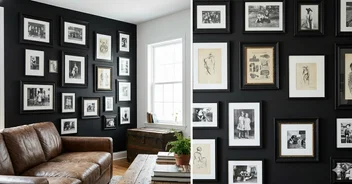




How to choose the best accent wall in 2026
Key Takeaways
- Placement beats colour. The wall opposite the entry, behind a fireplace, behind a bed, or holding a built-in, wins most of the time.
- On vibrant or saturated accent colours, Benjamin Moore Aura at ~$120 CAD/gallon earns its premium through Color Lock pigment binding (Benjamin Moore, 2026).
- Color Lock is about colour retention and washability, not one-coat coverage. Plan two coats every time.
- Deep and saturated colours add a ~$7 CAD/gallon deep base upcharge across every BM line.
- A professional single accent wall in Toronto runs $250 to $500 CAD with prep, primer where required, and two finish coats.
I'm Chad Caglak, co-owner at HomePaintersPro. Most homeowners pick a colour first, then hunt for a wall to dump it on. That's backwards. After 20 years on Toronto jobs I can tell you it costs people twice: once on the wrong wall, once on the wrong paint. If you would rather hand it off, choosing and painting the right feature wall is exactly what our accent wall painting service in Toronto does.
An accent wall is the highest-leverage decision in an interior painting Toronto project. Two questions this guide answers. Which wall? And which Benjamin Moore line belongs on it? Accent walls are the one room scenario where Aura's $20/gallon premium over Regal Select earns its keep. I'll also tell you which lines don't belong on an accent wall, and why.
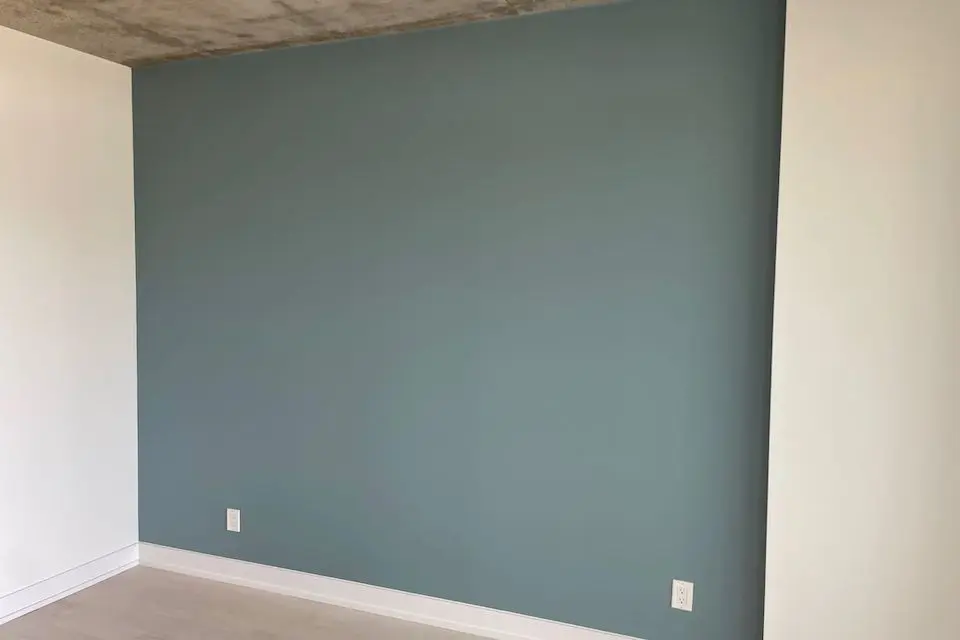
Why does placement beat colour on an accent wall?
Nearly every accent wall that works lands on a structural focal point: a fireplace, built-in shelving, or a vaulted ceiling, not a blank surface. When the wall already anchors the room, colour reinforces what your eye is doing anyway. On a fragmented wall full of windows and doors, even Aura in Hale Navy looks like someone ran out of ideas.
Your eye sorts a room in the first three seconds, and the wall in the direct sightline from the entry is the one it lands on. That's the reason a badly placed accent wall feels off in a way you can't name, and a well-placed one feels obvious.
In 20 years of Toronto work I've never had a client regret a fireplace wall, a headboard wall, or the wall straight across from the entry. I've lost count of the ones I've gone back to repaint because the homeowner picked a wall with three windows and a door.
Four things to check on every candidate wall
Before you think about colour, check every wall on these four points.
1. Entry visibility. The wall straight across from the entry door is almost always the strongest pick. Your eye lands there first and sets the tone.
2. Architectural focal points. Fireplaces, built-ins, exposed brick, shiplap, vaulted ceilings. The structure does half the work.
3. Furniture anchors. The wall behind the sofa, the bed, or the entertainment unit. Big furniture and bold colour reinforce each other.
4. Light exposure. North-facing walls flatten warm tones and dull mid-range chromas. South-facing walls at Toronto's latitude push warm hues up to 30% hotter than the paint chip. Test in the actual room.
Walls broken up by multiple windows, glass doors, or entry doors are out. The interruptions fragment the colour and your eye drifts through the glass instead of settling.
Which Benjamin Moore line belongs on an accent wall?
For saturated or vibrant accent colours, Benjamin Moore Aura at ~$120 CAD/gallon is the right call. Aura's Color Lock resin binds rich, deep pigments so they don't fade, drift, or burnish under washing (Benjamin Moore Aura technical data, 2026). That's what an accent wall needs. Depth that holds for a decade and a finish you can wipe.
Color Lock is pigment-binding chemistry, not one-coat chemistry. Almost every homeowner who walks into a BM dealer gets this wrong. On a Hale Navy or Caliente accent wall, Color Lock does three things: the second coat lays down without lap marks, the deep pigments don't flash or streak as the resin cures, and the colour reads true under direct light for years. It binds the pigment. It doesn't skip the second coat.
On a muted or pale accent colour (warm taupe, soft sage, greige, off-white), Aura's Color Lock isn't buying you much. There's barely any pigment to lock. Drop to Regal Select at ~$100 CAD/gallon and pocket the $20 per gallon. Result is nearly identical. Color Lock earns its premium on vibrant colour, not on white.
The deep base upcharge nobody warns you about
Accent walls almost always hit Benjamin Moore's deep base upcharge of roughly $7 CAD per gallon across every line. The reason is mechanical. Deep and saturated colours need a base with less white tint to leave room for more colourant. The base costs more to make, and dealers pass it through.
A gallon of Aura in a soft off-white sits at $120 CAD. The same Aura in Hale Navy, Dragon's Breath, Caliente, or any deep terracotta can ring up at $125 to $127. If your dealer quotes a flat per-gallon number, ask which base (pastel, medium, or deep) before you commit. On a whole-home repaint with multiple deep colours the surcharge stacks up. On a single accent wall it's a guaranteed line item.
What about Ben and Ultra Spec 500?
Ben at ~$80 CAD/gallon and Ultra Spec 500 at ~$55 CAD/gallon are fine paints. They're the wrong product for an accent wall.
Ben shows more roller stipple up close and has no Color Lock, so on a saturated wall under raking light you'll see texture and the colour won't hold its depth as long. Ultra Spec 500 is a fast-applying contractor paint I spec on ceilings, basement walls, rental turnovers, and low-traffic adult households where the walls aren't abused. It punches well above its price tier when the home is maintained. Household traffic and maintenance matter more than paint tier for longevity. But the surface still has to do the right job, and accent walls aren't Ultra Spec's job.
How many coats does an accent wall really need?
Two coats. Always. Every paint line, every colour, every wall in this country.
Over the chalky builder-grade flat GTA developers spray on, even Aura's first coat soaks in unevenly. The colour reads close but the sheen is blotchy and the film is too thin to wash without burnishing. The second coat fills roller skips, evens the sheen, and produces the uniform finish that one-coat rolling can't deliver outside a spray booth. Benjamin Moore's own spec sheet lists "1 or 2 coats" for Aura, but that hedge applies to the whole catalogue and assumes a perfectly primed, uniform substrate that almost no real Toronto home has (BM Aura spec sheet, retrieved 2026-05-26).
Last winter, High Park dining room, Cheating Heart on the wall behind the table. Client had been to the dealer twice, came home convinced Aura was a one-coat paint, and asked if she could save a gallon. I put down one coat. At noon it looked passable. By 3 p.m. the sun swung off the south window, hit the wall sideways, and the whole thing went striped. Roller paths, soft halos around the cut-in, the kind of mess that makes you look at your shoes. The second coat, same gallon, killed every defect inside 30 minutes of drying. Same thing happened on a Hale Navy accent in a Bloor West Village living room a month later. Anyone who tells you they got a deep colour in one is either standing too far back or hasn't seen the wall at 4 p.m.
While we're killing myths: "paint and primer in one" doesn't mean you can skip priming. That label is about hide (opacity over small filler spots), not primer function. New drywall, water stains, smoke damage, raw wood, or a dark colour change all still need real primer. Zinsser BIN for stains, Benjamin Moore Fresh Start for new drywall, a bonding primer for glossy surfaces. Skip it on an accent wall going dark-over-light and you'll see flashing and patches inside a few weeks. For the full prep workflow, see how to prep walls for painting.
Saturation versus coats: the chart
Paying for Aura on a saturated wall is also paying for the second coat to actually finish the job. On Ben or Ultra Spec, a deep colour like Hale Navy often pushes into a third coat before the sheen reads even, which eats the per-gallon savings fast.
What is the picture-framing defect and why does it kill accent walls?
Picture-framing (we call it boxing in the trade) is the number-one reason an accent wall looks great on day one and terrible a year later. It happens when a painter cuts the edges in with a brush, then rolls the wall only once. The cut-in band has two coats. The rolled middle has one.
Inside 12 months, the under-coated middle fades and burnishes faster than the double-coated edges. A darker frame shows up: a thicker band along the ceiling line, around the trim, into the corners, with a washed-out lighter rectangle in the middle. On a Hale Navy or Dragon's Breath wall it's brutal. Looks like someone painted a picture frame on your accent wall.
The fix is non-negotiable. Cut in, roll the first full coat into the still-wet cut-in band, then cut in again and roll the second full coat into that second wet band. Two real cut-ins and two real roller coats everywhere on the wall, including under the cut-in. This is the fastest way to read whether a painter knows the trade. A one-year-old accent wall with no boxing means the painter cut in twice. A one-year-old wall with a visible frame means they cut in once.
If you're paying for Aura's Color Lock on a saturated wall, boxing is the defect that wastes the money. Color Lock binds the pigment. It can't rescue a wall that was single-coated in the middle.
Where the colour should stop: terminate on an inside corner
One execution detail decides whether your colour break reads intentional or sloppy: end the accent on an inside corner, never on an outside one. An inside corner is the recessed seam where two walls meet and turn away from you, like the corner behind a sofa. An outside corner is the protruding edge that juts toward the room, the kind you'd bump with your shoulder. Stop a deep colour on that protruding edge and the cut line catches direct light from both sides, so every wobble in the brush line broadcasts itself. Land it in the shadowed recess of an inside corner instead, and the same cut-in looks like a clean, deliberate break.
This pairs with the cut-in craft above. A painter who cuts in twice for two full coats still needs to choose the right corner to stop on, or the careful film does the wrong job. On a fireplace or built-in wall the structure usually hands you an inside corner for free. On an open run, plan the colour change so it dies into the recessed corner, not the one sticking out into the room.
What does a professional accent wall cost in Toronto?
A standard accent wall in Toronto runs $250 to $500 CAD in 2026 for a typical wall up to roughly 120 square feet. That covers surface prep, a primer coat where required (always when going dark-over-light), two finish coats in Aura or Regal Select, and clean cut lines. For the full breakdown, including the hidden line items and what an accent wall returns at resale, see our accent wall cost guide.
Where the price moves:
- Wall size and ceiling height. 10-foot ceilings or anything wider than 14 feet push toward $500 to $700 CAD.
- Primer requirements. Dark-over-light or stained drywall needs a tinted primer. Add $40 to $80 in materials.
- Deep base upcharge. Saturated colours add roughly $7 CAD per gallon. One gallon, $7 line item. Feature wall plus return walls, more.
- Paint line. Aura at $120 CAD/gallon versus Regal Select at $100. On a single-gallon job that's $20 to $27 in materials.
For full room and whole-home painting budgets, see the cost to paint a house Toronto guide.
The ROI math holds up in practice, even if I would not trust any published percentage. A well-placed accent wall in a confident colour is one of the highest-leverage moves a Toronto homeowner can make before listing. Most accent walls we paint go in as part of a wider interior painting job in Toronto, which is where the colour on the other three walls gets chosen to frame it.
Where should the accent wall go in each room?
Match the wall to what the room actually does. The big rules hold across every layout I've painted in Toronto.
Living rooms. The wall behind the main seating, the fireplace wall, or the wall you see from where people actually sit. Most of our living room painting jobs in Toronto build the accent around that focal wall. Skip the TV wall if the TV is already commanding the room.
Bedrooms. The wall behind the bed wins about 80% of the time. The bed is doing the visual heavy lifting and the colour reinforces it. If the bed is on a windowed wall, switch to the wall opposite, the one you see first when you wake up.
Home offices. The wall behind the desk, or the wall you face while working. Deep grounded colours (charcoal, deep teal, navy) hold focus without going stark. Prime Aura territory because the colour matters.
Kitchens. An uninterrupted wall opposite the work area, or the wall visible from the dining space in open-concept condos. Skip the wall behind the stove. Heat, steam, and grease degrade every line.
Bathrooms. If you're doing a bold accent in a bathroom, use Aura Bath & Spa, not standard Aura. Same ~$120 CAD pricing, mildew- and mold-resistant coatings, Zero VOC. Standard Aura wasn't engineered for daily shower steam.
How do you pick the right accent colour for your wall?
Once placement is locked in, colour gets simpler. Two strategies work and most homeowners overcomplicate it.
Contrast. Pick a colour clearly different from the other walls. Deep navy against cream. Charcoal against pale grey. Emerald against off-white. Aim for a Light Reflectance Value (LRV) gap of at least 30 points between accent and surrounding neutrals. Benjamin Moore Hale Navy HC-154 has an LRV around 4; Chantilly Lace OC-17 sits near 92, a gap of 88 points. That's why the pairing reads dramatic even under Toronto's overcast winter light.
Harmony. Pick a colour related to your existing walls but deeper. Warm taupe accent with pale taupe walls. Muted sage with cream. Depth without shock. This is where Regal Select makes more sense than Aura. Muted tones have less pigment to lock.
For deeper colour theory and how Toronto light shifts shades by season, see the paint colour guide. Always test sample pots two feet by two feet on the actual wall, in actual light, for at least 48 hours before committing.
Frequently Asked Questions
No. Over builder-grade flat (what 90% of Toronto homes have), Aura still needs two full coats to deliver its colour depth, sheen uniformity, and Color Lock washability. The one-coat marketing claim only holds when you are recoating the same Aura colour already on the wall. On a fresh accent wall in Hale Navy or Dragons Breath, plan on two coats every time. Anyone telling you otherwise has not rolled a deep colour under raking light.
Saturated and dark colours trigger a deep base upcharge of roughly $7 CAD per gallon across every Benjamin Moore line. Deep colours need a base with less white tint to leave room for more colourant. The base itself costs more to produce, and dealers pass that through. A gallon of Aura in a soft white sits at $120 CAD; the same Aura in Hale Navy can ring up at $125 to $127 CAD. Accent walls almost always trigger this charge.
When your colour is vibrant or saturated. Auras Color Lock resin binds rich pigments tightly so they do not fade, drift, or shift over years. For Hale Navy, Caliente, Dragons Breath, deep terracotta, or any jewel tone, pay for Aura. For muted sage, warm taupe, or soft greige, there is barely any pigment to lock and Regal Select gives a near-identical result for roughly $100 CAD per gallon. Save $20.
Yes. Repainting a single accent wall in Toronto typically costs $250 to $500 CAD depending on size, paint line, and whether you are going dark-over-light (primer required) or staying in the same depth range. That makes accent walls the cheapest way to refresh a room without committing to a full repaint. Budget two coats every time, and add a tinted primer coat if you are covering a deep colour with anything lighter.