




Brick painting vs. staining in Toronto: what homeowners need to know
Quick Answer: Paint sits on top of brick as an opaque film and needs repainting every 8 to 15 years. Penetrating stain bonds inside the brick, breathes, and lasts 15 to 25 years. Romabio limewash is mineral-based, breathable, partially reversible, and the historically correct choice for heritage Toronto homes. Per the Brick Industry Association Technical Note 6, any coating that blocks vapour transmission risks freeze-thaw spalling on cold-climate brick.
The most expensive mistake I see on Toronto brick is a homeowner painting a wall that should have been stained or limewashed. Then comes the peeling, the spalling, and a repaint bill every decade. Twenty years on this stuff, from 1890s Victorians in Cabbagetown to post-war bungalows in Scarborough and North York, and that is the one call I most wish people made before the first coat went on.
Three legitimate options, paint, penetrating stain, limewash. Real CAD pricing, product specs, and an honest warning about what's reversible and what isn't. For the wider context, see our residential painting guide for Toronto homes. exterior painting Toronto
Key Takeaways
- Painting brick is largely irreversible. Soda blasting damages mortar and erodes the brick face. Plan to keep it or repaint.
- Penetrating stain breathes, paint seals. Toronto freeze-thaw punishes any coating that traps moisture inside the wall.
- Limewash (Romabio Classico) is the historically correct choice for Victorian Cabbagetown, Wychwood, and Rosedale brick. 15 to 20 year service life per the manufacturer TDS.
- Real 2026 CAD pricing: paint $5 to $10/sq ft brick face, stain $3 to $6/sq ft, limewash $4 to $8/sq ft, plus 13% HST.
- Never accept "self-priming" claims on chalky, weathered, or previously painted brick. Bonding primer (INSL-X STIX) is required.
Across 700+ Toronto brick assessments I've logged since 2005, roughly 1 in 4 painted brick homes show visible spalling or paint failure within 7 years. Almost always wrong primer choice or pre-existing moisture the homeowner didn't disclose.
What's the real difference between painting and staining brick?
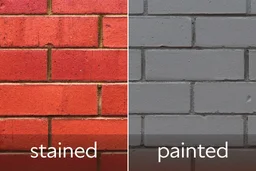
Paint forms a film on the surface. Stain penetrates the masonry and bonds chemically with the silica in the clay. That one difference, on top versus inside, drives every downstream consequence: breathability, reversibility, lifespan, cost. The Canadian Conservation Institute warns that impermeable coatings on historic masonry accelerate deterioration in freeze-thaw climates.
Paint blocks the pores. Toronto averaged 61.9 observed freeze-thaw cycles per year over the 1971 to 2000 baseline (City of Toronto, Toronto's Current and Future Climate, Appendices, retrieved 2026), so trapping moisture behind a paint film is a slow-motion failure. Water gets in through cracks, mortar joints, or vapour from inside the wall. It can't escape outward. It freezes, expands roughly 9%, and pushes the brick face off in flakes. That's spalling, and you can't undo it.
Stain doesn't block pores. The brick still manages moisture the way the original mason designed it to. That's why penetrating stain is the safer long-term call on most older Toronto masonry.
The painted-brick look you see on Instagram is mostly a US south and California thing, where freeze-thaw isn't a real stressor. Copying it in Toronto without changing the product spec is how you end up with spalled brick by year five. I had a client in Wychwood show me a Pinterest board of Atlanta white-brick bungalows and ask for the same finish on her 1908 semi. We talked through the chemistry for an hour before she agreed to limewash instead.
Is painting brick really irreversible in Toronto?
For practical purposes, yes. Once cured masonry paint has wicked into the pores, removal means chemical stripping, soda blasting, or sandblasting. Each option costs a lot, damages the brick, or both. The National Park Service Preservation Brief 1 advises against abrasive cleaning on historic brick because it removes the fire-skin and exposes soft interior clay.
The irreversibility reality:
- Chemical stripping runs $8 to $14 per sq ft in Toronto, takes multiple applications, and still leaves residue in the pores. The brick rarely looks "original" after.
- Soda blasting is gentler than sand, but it chews up mortar joints. On a Victorian with lime mortar, soda blasting often forces full repointing afterward at $15 to $30 per linear foot.
- Sandblasting strips the hard fire-skin off the brick face. The softer interior brick underneath drinks water. Spalling within two winters is common.
Before you paint, accept the deal: you're committing to a repaint every 8 to 15 years for the life of the building, or living with the painted look indefinitely. No clean reset button. For how that cycle compares against wood, stucco, and metal siding, see our repaint intervals by cladding type.
What are the pros and cons of painting brick in Toronto?
Painting brick gives you full opaque colour and the most dramatic visual change. The trade is a guaranteed maintenance cycle and real moisture risk if the wrong system goes on. Toronto averaged 61.9 observed freeze-thaw cycles a year over the 1971 to 2000 baseline (City of Toronto, Toronto's Current and Future Climate, Appendices, retrieved 2026), so vapour permeability isn't optional. It decides whether paint lasts 5 years or 12.
Pros:
- Full opaque colour change. White, charcoal, deep green, whatever.
- Hides mismatched repointing or replaced brick patches.
- Lower upfront cost than stain per sq ft.
- Easier to wipe down. The smoother painted surface sheds pollen, soot, and road dust with a hose or a sponge, where raw porous brick holds that grime in its pores. It's a small day-to-day win, but a real one near busy Toronto streets.
Cons:
- Traps moisture if you skip a vapour-permeable masonry primer. Standard exterior latex on brick is malpractice.
- Locks you into an 8 to 15 year repaint cycle. $5,000 to $10,500 every cycle on a typical bungalow.
- Effectively irreversible without damaging the brick.
- Peels at the mortar joint edges first, then sheets off the face.
1957 Don Mills bungalow last summer. Previous owner rolled cheap exterior latex over the original red brick in 2018. By year 5, hairline lift around every mortar joint. By 2025 the south and west faces were peeling in sheets, and three brick faces had spalled where moisture got trapped behind the film. Fix was full chemical stripping, repointing two window surrounds, respraying with Loxon XP. Total came in at 2.4x what a proper Loxon system in 2018 would have cost.
What are the pros and cons of staining brick?
Penetrating stain is the long game on most Toronto brick. Per Cabot Masonry Stain technical data, a properly applied water-based penetrating stain runs 15 to 20 years with no recoat, because the colour is bonded inside the brick instead of sitting on top where UV and freeze-thaw can attack it.
Pros:
- Breathable. Brick keeps managing moisture normally.
- 15 to 25 year lifespan. No peeling, no flaking.
- Shows brick texture and mortar character. That's most of the charm on older Toronto walls.
- Lower 20-year total cost than paint on most homes.
Cons:
- Can't lighten brick. You can shift red to brown, brown to charcoal. You can't go from red brick to white without paint.
- Skill ceiling is higher. Bad application streaks or blotches that don't wash out.
- Effectively permanent. Restaining in a compatible or darker tone is your only correction.
best time to paint exterior Toronto applies to stain too. Mid-May through mid-September, brick dry, overnight temps above 10°C.
What is limewash and why is it the right call for heritage Toronto brick?
Limewash is slaked lime, calcium hydroxide, mixed with water and mineral pigments. It carbonates into the brick surface over weeks as it reacts with atmospheric CO2, forming calcium carbonate that bonds with the masonry. Not paint, not stain. The leading product is Romabio Classico Limewash, a mineral-based, zero-VOC formula rated for North American masonry with a 15 to 20 year service life per the published TDS.
Why limewash suits Toronto heritage brick
The soft-fired red and buff brick in Toronto's Victorian and Edwardian stock, found across Cabbagetown, Wychwood Park, Rosedale, and pockets of the Annex, was originally finished with lime-based washes or left bare. Hard modern acrylic paint is the wrong language for these walls. City of Toronto Heritage Preservation Services guidelines for designated properties discourage impermeable coatings on original masonry for the same freeze-thaw reasons.
Limewash speaks the same chemistry as the original lime mortar. It carbonates, breathes, and weathers into a soft patina instead of peeling.
Did a Carlton Street semi in Cabbagetown three summers back. Owner had been quoted a full paint job in a "warm white" by another crew. We pulled the trim back, found original lime mortar in good shape under a century of soot, and brushed two coats of Romabio Bianco. Three years in, it's softened to a chalky cream that looks like it's been there since 1898. That's the look you can't fake with acrylic.
Romabio Classico spec at a glance
- Base: Slaked lime (calcium hydroxide), mineral pigments
- VOC: 0 g/L (zero VOC)
- Vapour permeability: Very high, fully breathable
- Service life: 15 to 20 years per manufacturer TDS
- Coverage: 200 to 350 sq ft per gallon, two coats standard
- Substrate: Bare, unsealed brick, stone, or stucco. Will not bond over existing paint.
Reversibility advantage
Within the first 5 days after application, Romabio Classico can be partially or fully pressure-washed off to adjust opacity. That's how you get the "distressed" or European look many heritage clients want. After full cure (roughly 30 days), removal is still easier than paint stripping because limewash sits in the top few millimetres instead of impregnating deep. Most forgiving of the three finishes.
Limewash limitations
- Won't adhere over existing paint. Brick must be bare or previously limewashed.
- Colour palette skews white, off-white, warm earth tones. Saturated colours aren't its language.
- Weathers and lightens naturally. Some clients love the patina, some find it unpredictable.
- Application matters. Two thin coats brushed in a cross-hatch pattern. Not rolled, not sprayed, if you want a true Classico finish.
exterior brick painting and staining Toronto covers our limewash, stain, and paint scopes.
How does Toronto freeze-thaw stress affect each brick coating?
Toronto sits in one of the harshest freeze-thaw zones among populated regions in North America, averaging 61.9 observed cycles a year over the 1971 to 2000 baseline (City of Toronto, Toronto's Current and Future Climate, Appendices, retrieved 2026). Every cycle, water inside the brick or behind a coating expands about 9% as it freezes. That's the mechanical force that destroys masonry coatings.
How each finish responds:
- Paint: Worst. The film acts as a vapour barrier. Moisture from interior walls, rain at mortar joints, or rising damp gets trapped behind the film, freezes, pushes the paint off the wall. Spalling of the brick face follows within 2 to 5 winters on a bad system.
- Penetrating stain: Best for cold-climate brick. Brick still breathes. Moisture moves through normally. Pigment is bonded inside, so freeze-thaw can't lift it.
- Limewash: Strong. Carbonated calcium carbonate is chemically similar to the brick and mortar itself. It expands and contracts at compatible rates. Weathers gracefully instead of failing in sheets.
I push back hard when a client wants painted brick on a 1920s Riverdale semi. The substrate and the climate are telling you what to use.
How much does brick painting vs staining vs limewash cost in Toronto?
The 2026 CAD ranges below cover labour, materials, standard prep, and mobilization for a typical two-storey detached. Add 13% HST. Repointing, full stripping of failed prior coatings, or scaffold-only access push costs higher. exterior house painting cost Toronto covers the full exterior breakdown. Brick is usually one piece of a full house painting job that also covers trim, soffits, and eaves, so factor those in when you budget.
Deep or saturated tints on Cabot stain or Loxon XP add up to $7 per gallon because they need a deep base with less white tint. Worth knowing before you fall in love with a charcoal or oxblood swatch.
| Option | Cost per sq ft (brick face) | Lifespan | 20-yr total cost (700 sq ft home) |
|---|---|---|---|
| Masonry paint (Loxon XP system) | $5 to $10 | 8 to 15 years | ~$8,500 to $17,000 |
| Penetrating stain (Cabot) | $3 to $6 | 15 to 25 years | ~$2,500 to $5,200 |
| Limewash (Romabio Classico) | $4 to $8 | 15 to 20 years | ~$3,800 to $8,400 |
All prices CAD, exclude 13% HST. Assumes ground-level access; scaffold adds $2,000 to $6,000 depending on building.
For a 700 sq ft typical bungalow brick face:
- Paint: $3,500 to $7,000 initial, plus a second cycle within 15 years.
- Stain: $2,100 to $4,200 initial, often no recoat for 20 years.
- Limewash: $2,800 to $5,600 initial, touch-up or full reapplication in 15 to 20 years.
Over 20 years stain is the cheapest total-cost option. Limewash is close behind. Paint is the most expensive lifetime choice even though it often looks cheapest on the initial quote.
What products should you use for brick coatings in Toronto?
Product selection is where most failed brick jobs start. Standard exterior latex, "paint-and-primer-in-one" claims, and skipping bonding primer on chalky or previously painted brick. Those three errors account for most of the failures I'm called in to fix. Self-priming claims don't survive chalky, weathered, or previously painted Toronto brick. Plan for a real bonding primer. Here's what I actually spec in 2026. Staining horizontal wood rather than masonry follows different rules again, which we cover in our deck stain comparison.
| Product | Use case | Why it matters |
|---|---|---|
| INSL-X STIX Bonding Primer | Primer over chalky, weathered, or previously painted brick | Urethane-modified acrylic. Bonds where standard primers fail. Required, not optional, on compromised masonry. |
| Sherwin-Williams Loxon XP | Masonry paint, exterior brick and block | 100% acrylic, vapour-permeable, rated for direct application to masonry. The Toronto freeze-thaw workhorse. |
| Benjamin Moore Aura Masonry | Masonry paint, premium option | Excellent hide and fade resistance; on chalky, weathered, or previously painted brick, still spec a bonding primer (Stix or Loxon Conditioner), "self-priming" claims do not hold on real Toronto masonry |
| Cabot Masonry Stain | Penetrating stain, brick and concrete | Water-based penetrating formula. Custom-tintable. 15 to 20 year published performance. |
| Romabio Classico Limewash | Limewash, heritage and Victorian brick | Mineral-based, zero VOC, fully breathable, historically correct for pre-1940 Toronto brick. |
Don't let any contractor sell you on a "self-priming" product as a substitute for INSL-X STIX or equivalent bonding primer on chalky, weathered, or previously painted Toronto brick. The bond fails inside two winters and you're repainting on your dime.
Which option is right for your Toronto home?
Decision logic from 20 years of Toronto brick assessments:
Choose masonry paint if:
- You want a dramatic colour change, especially going lighter or to white.
- Brick is sound, fully cured (older than 10 years), no spalling, no efflorescence.
- You're fine with a $5,000 to $10,500 repaint cycle every 8 to 15 years.
- The substrate is properly prepped with bonding primer and a vapour-permeable masonry topcoat.
Choose penetrating stain if:
- You want the longest-lasting, lowest-maintenance finish.
- Your colour goal is darker or a shifted tone, not lighter.
- The brick has character worth preserving.
- You want to minimize freeze-thaw risk.
Choose limewash (Romabio Classico) if:
- You own a Victorian, Edwardian, or pre-war home, especially in Cabbagetown, Wychwood, Rosedale, or the Annex.
- You want a heritage-appropriate, breathable, partially reversible finish.
- You like a soft, mottled, weathered look.
- The brick is bare or previously limewashed (not painted).
For 1950s to 1970s post-war bungalows in North York and Scarborough, my default is penetrating stain. For Victorian and Edwardian heritage homes, limewash. Paint is the right call only when full opaque colour change is the goal and you've signed up for the maintenance.
The bottom line
Product matters less than the painter. I've seen Loxon XP fail in 5 years because the prep was rushed. I've seen $30/gal paint outlast its warranty because the crew took the time to wash, repoint, prime, and apply two full coats. Brick coating decisions are 20% product, 80% prep and craft. Especially in Toronto's climate.
Before you commit to paint, stain, or limewash, get an in-person assessment from someone who's worked on Toronto brick specifically. Climate, neighbourhood, brick age, and how much maintenance you can stomach all matter.
Questions about your brick? Call me at (416) 875-8706 or request a free in-person assessment. I look at every brick job in person before any quote or work begins.
The full scope and process are on our exterior brick painting and staining service page.
About the author
Chad Caglak is co-owner of Home Painters Pro Toronto and a 20-year working painter. He's coated Toronto brick every way there is, paint, penetrating stain, and heritage limewash, on everything from Victorian semis in Cabbagetown to post-war bungalows in Scarborough, and writes the craft-and-pricing content here so Toronto homeowners can pick the finish their wall can actually live with instead of spalling it off in five winters. Read more in how often to repaint by cladding type or the exterior house painting cost breakdown.
Frequently Asked Questions
Essentially no. Once latex or acrylic masonry paint has cured into brick pores, full removal is extremely difficult. Chemical strippers soften the film but residue stays in the pores. Soda blasting and sandblasting damage the mortar joints and erode the fired clay face, exposing softer interior brick that then absorbs water and spalls in the next freeze-thaw cycle. Plan to live with paint, or repaint, not strip.
Paint sits on top of the brick as an opaque film, blocking pores and requiring repainting every 8 to 15 years. Stain penetrates the brick, allows it to breathe, shows the natural texture, and lasts 15 to 25 years. Paint offers full colour coverage. Stain produces a semi-transparent, natural result that respects the original masonry character.
Brick painting in Toronto runs $5 to $10 per square foot of brick face for the paint system itself, plus prep, repointing, and mobilization. Penetrating stain runs $3 to $6 per square foot. Romabio limewash runs $4 to $8 per square foot. A typical 700 sq ft bungalow paint job lands at $6,000 to $10,500 plus 13% HST.
On the initial job, yes, often by 30 to 40%. Over 20 years stain is dramatically cheaper because there's no recoat cycle. A $4,000 stain job often beats a $6,000 paint job that needs another $7,000 in year 10. how to repair exterior stucco Toronto covers similar lifecycle math for stucco.